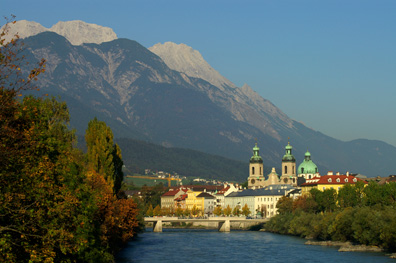
Experience 24 Hours in Innsbruck

Innsbruck, Austria

Photos courtesy Innsbruck Tourism

Innsbruck’s beautiful medieval Old Town, set against the backdrop of majestic peaks, is everything you picture a quintessential Alpine town to be. Yet its quaint appearance can be deceiving: a one-day tour will reveal a rich and varied side of Tirol’s capital underneath layers of ancient history and cherished tradition.

MORNING
Before you do anything else, purchase a 24-hour Innsbruck Card either at your hotel or at the Innsbruck Information Office in the Old Town. This grants you access to all museums, public transportation, one roundtrip on any of Innsbruck’s lifts and cable cars and guided tours. Armed with the card, you are now set to start your day with a tour of the historic city center. You’ll love the colorful medieval buildings, vaulted walkways and stuccoed facades.

Golden Roof

Innsbruck’s landmark, the Golden Roof, is famously covered with exactly 2,657 gilded tiles and overlooks the main square. In the 15th century, the Habsburg family ruled their empire from Innsbruck’s Hofburg Imperial Palace.

See the Imperial Apartments and exhibitions at the palace, then stop at the adjacent Hofkirche Court Church, where one of the most important cultural monuments in Tyrol is on display: 28 larger-than-life bronze figures surround the 16th century tomb of Emperor Maximilian I, representing his heroes of antiquity and his ancestors. The quaint alleys of the Old Town also house many small boutique stores offering handcrafted Tyrolean products that make for excellent souvenirs.

AFTERNOON
For lunch with a view, head past the Hofburg Imperial Palace to the Nordkettenbahnen Cable Cars. The funicular stations were designed by star-architect Zaha Hadid, and their sleek modern design contrasts beautifully with the surrounding landscape and historic architecture of the city.

Only 20 minutes later you’ll find yourself at 6,500 feet, near the top of the Nordkette Mountain range. Head to the restaurant at the Alpenlounge Seegrube and enjoy the breathtaking views over Innsbruck and the Austrian Alps. If you want to continue your mountain experience, head to the Innsbruck Alpine Zoo. Europe’s highest zoo features more than 2,000 animals including bears, wolves, eagles and many other species native to the region. To get there, simply take the Nordkettenbahnen back down the mountain and get off at the Alpenzoo Station. Otherwise, head straight back to the city in the early afternoon. It’s time to explore Innsbruck’s excellent shopping street, the Maria-Theresien-Strasse. Within view of the Golden Roof, the grand boulevard is located in a pedestrian area and—among many smaller shops and boutiques—houses two shopping centers: the ultra-modern Kaufhaus Tyrol designed by David Chipperfield and the Rathaus Galerien with boutique stores featuring well-known luxury brands. Don’t miss the Swarovski Flagship Store in the Old Town.

Maria Theresien

Another option for outdoor enthusiasts is to spend the afternoon taking part in Innsbruck’s fabulous summer hiking program. Visitors to Innsbruck and its 25 holiday villages can use the hiker’s bus with their Guest Card and explore the region with a free mountain guide. Even the equipment rental is free of charge with your Guest Card. Simply make a reservation through your hotel the day before.

EVENING
You don’t really know a destination until you have sampled its food. Tyrol is famous for its hearty fare, such as Tiroler Gröstl (meat, potatoes, and onions topped with a fried egg) and a large variety of sweet and savory dumplings. The famous Café Sacher, a traditional Viennese coffee house and restaurant, as well as the Ottoburg, the Weisses Rössl or the Goldener Adler in the Old Town all feature excellent authentic cuisine. After dinner, head to the newly-opened Adlers hotel, housed in one of the city’s tallest buildings and enjoy a cocktail on the rooftop terrace, ending the day with a stunning view of Innsbruck by night.

For more info, go to www.austria.info/us or www.innsbruck.info/en
The 10 Commandments for Travelers

1. Thou shalt not expect to find things precisely as they are at home… for thou hast left home to find things different.

2. Thou shalt not be unhappy with schedule changes…for schedule changes are inevitable and part of great adventure.

3. Remember to take half as many clothes as thou thinkest and twice the money.

4. Thou shalt not let other travelers get on thy nerves…for thou art paying good money to enjoy thyself.

5. Thou shalt not judge an entire nation by one person with whom thou hast had a problem.

6. Thou shalt carry a passport at all times, for a person without a passport is a person without a country.

7. Thou shalt not look to assign blame when problems arise, for we are all in the boat together.

8. Thou shalt not worry, for he that worrieth hath no pleasure…and few things are fatal.

9. When in Spain and Portugal, do as the Spaniards and Portuguese do.

10. Remember that thou art a guest in other lands and he that treats his host with respect shalt be an honored guest.

Mark Waldron

Travel to Europe Like a Pro

Whether it’s your first time to Europe, a romantic vacation for two to Paris or a family trip to London, international travel can seem a little daunting. With proper planning, you can kick off your vacation on the right foot.

1. Educate yourself on the culture: It is important to be mindful of other cultures when travelling internationally. Be sure to study up on any common cultural mistakes that travelers make when entering the country you are visiting. This will safeguard you from making the same embarrassing and offensive mistakes.

2. Review rules on air travel and luggage: Save time (and stress) at the airport by checking the TSA website’s list of prohibited items. No one wants to start a trip having to repack their luggage at the airport or getting stuck in customs.

3. Make copies of important papers: most people know that proper documentation is needed for international travel, but how many people think to bring copies with them? Take the time before you leave to keep a copy of all your documentation in your email, just in case something happens. Have an unlocked mobile phone? Be sure to keep a copy on there too. (If you don’t, think about purchasing one.)

4. Check out the local forecast: in order to know what to pack, it is important to know the typical weather where you are going in the time frame you are going. You should also check the local weather a few days before you leave.

5. Purchase an unlocked cell phone: Stay connected with those at home by purchasing an unlocked mobile phone. Purchasing an unlocked GSM phone will allow you to access pay-as-you-go plans internationally, saving on roaming fees. This kind of connectivity can give you piece of mind in knowing, wherever you are, you are always connected.

Courtesy of Ahmed Khattak and GSM Nation

Spend St. Valentine’s Day in Dublin

If a short break is on your agenda for St. Valentine’s Day, perhaps you need a push from the man himself — St. Valentine. Wouldn’t you know it? The Irish actually have relics (some of the remains) of the patron saint of lovers.

You need to head to Dublin for this. The St. Valentine’s Shrine is in Whitefriar Carmelite Church, Aungier Street, a few minutes walk from Grafton Street, St. Stephen’s Green and the famous Temple Bar, the center of Dublin’s shopping, culture and craic in the Irish capital.

If you can, visit St. Valentine’s Shrine on February 14 itself—the saint’s actual feast day, and the origin of the annual celebration of love, although it’s still a place of pilgrimage for those celebrating love at any time.

You can do a lot in Dublin on a long weekend. In Europe’s friendliest city; you can talk to anyone. It’s said the city is as intimate as a pub. But it’s probably better not to over-prepare for Dublin, or anywhere in Ireland. Be ready to go with the flow, build in one or two key activities and expect the locals to throw a surprise or two your way.

Dublin hotels and restaurants will be pulling out the stops to create a traditional romantic atmosphere on Valentine’s night, so candle-lit dinners will be the norm. Flowers are no problem either— Smithfield Flower Market — and one Dublin temple to the art of all things— chocolate— is actually not far from St. Valentines’ Shrine. Chocolatier Cocoa Atelier on Drury Street oozes handmade Irish chocolate deliciousness.

Finally, the all-important card.The Emerald Isle’s charm is more along the style of literary son Sheridan: “Won’t you come into the garden? My roses should like to meet you.”

Ireland is a land that reaches deep into the heart, lifts spirits and stirs you to your very core.

For more information, go to: www.discoverireland.comwww.galwayonline.com and www.visitdublin.com

Munich’s Big Bash

Celebrating 850 Years of Bavarian Delights

By Marilyn Heimburger
Photos by Don Heimburger and courtesy Munich Tourist Office

I have always liked Munich. Actually, it’s more than just liking the city. I feel moved by its vibrant life, its stimulating nature and its friendly people. Apparently many more feel the way I do, since it is Germany’s most-visited city.

Last year, during Munich’s 850th birthday, the city of 1.3 million hosted the following:

  • City Foundation Festival in June in the heart of the city, featuring traditional Bavarian culture and international folk culture. A highlight of the fest was a Gaufest, or regional festival, of the many associations for folk culture where dancing and costumes from the Isargau region were prominent. As many as 10,000 participants were involved in this. A group of 100 rafters from the Oberland region showed how to build a raft. Dance masters showed how to learn the “Munich-Francaise” dance.
  • In July, the Old Town Ring, which was free from automobile traffic, served as the center for a celebration of theater, music, dance, games and sports on many stages. Scenes from peasant life in Munich with markets, street theater and beer gardens were staged. There also was music from international bands and more.
  • In August, the three-day Isar Bridges Festival, centered around the Cornelius, Ludwig and Maximilian bridges, highlighted the Isar River (which flows through the city) as the city’s life-giving artery. There was music under the bridge, dancing along its banks, glittering lights on the water, and with this came Munich’s famous culinary delights. An action theater group, which encouraged audience participation, also presented skits. There were also night-time water and laser shows
  • Additional highlights included the world premier of a work commissioned from composer Victoria Borisova-Ollas especially for the 850th anniversary. In June the Cuvillies Theater, one of German’s most elegant Rococo theaters, reopened after a spectacular renovation. In the newly re-designed St. Jakobs-Platz, many of the local museums and community organizations held programs of music ranging from classical to klezmer (a musical genre), dancing and creative street theater, exhibitions, tours and more.
  • Many of Munich museums featured exhibits of famous Munich artists, writers and Munich’s cultural heritage.

As Munich’s Lord Mayor Christian Ude said, “(Munich’s) celebrating its 850th foundation day…is nothing exceptional. What is remarkable is the city’s rapid growth from a monastery on a hill to a European metropolis with over a million inhabitants and a high-tech hub.”

As Ude says, the city is special because of its enduring and much-praised flair as a place with a zest for life.

The settlement of Munichen was originally granted the right to market goods and mint coins in June of 1158. In 1214 it was granted status as a town, and in 1255 it became the seat of the Wittelsbach dynasty. Under Kind Ludwig I, many famous buildings were erected, making Munich a major cultural center, and in 1918 the Free State of Bavaria was formed.

For travelers, the city offers 355 hotels and pensions with 45,500 hotel beds available. In 2006, 4.4. million tourists booked nearly nine million overnight stays, with 47% of them from overseas, with the USA bringing in the most, followed by Italy, Great Britain, Austria and Switzerland.

The city boasts three universities and eight colleges, 60 theaters and an opera house, 45 major museums, three symphony orchestras—and it hosts the famous 16-day Octoberfest beginning on the Saturday two weeks before October.

Favorites for visitors to see in Munich include:

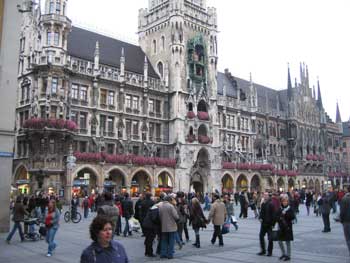
  • The city’s twin onion-domed towers of the Frauenkirche, Church of our Lady, Frauenplatz 1, is the city’s best-known landmark.
  • Marienplatz and the glockenspiel on the Marienplatz in the city center displays the mechanical dancers in the tower of the Rathaus (Town Hall) at 11 a.m. and noon (and 5 p.m. in the summer).
  • Schloss Nymphenburg is the impressive Baroque palace built as the summer residence for the Bavarian Electors. Today the main building houses a museum.
  • The Viktualienmarkt is Munich’s oldest market, originally begun as a farmer’s market and now a favorite place for a wide range of produce, Bavarian specialties and more.
  • The Hofbrauhaus deserves a visit, as its one of Munich’s best-known restaurant-breweries at Am Platz 9. Great dining is available, or just casual drinking and listening to oom-pah music. For information on the Hofbrauhaus, visit www.hofbraeuhaus.de.
  • There are many churches to visit, including the Asamkirche built by the Asam brothers in the 18th century with its spectacular interior at Sendlinger Strasse 62; Church of the Sacred Heart, a cubed-shaped structure with an innovative facade at Romanstrasse 6; and Saint Peter’s, Munich’s oldest parish at Rindermarkt 1.
  • The Deutsches Museum at Museumsinsel 1 houses sailboats, windmills, space probes, robots, ships, trains, planes and much more. Allot a whole day for this attraction.
  • Octoberfest Museum, at Sterneckerstrasse 2, will tell you all about the history of beer including how it started as a drink at monasteries, and all about the city’s famous Octoberfest celebration.
  • The expanded BMW Museum is a must-see if you are fascinated with automobiles and engineering. Tours are available.

Munich is waiting to wow you.

IF YOU GO…
You can arrive at Munich’s Airport, which is like a city within itself. Flights from numerous major hubs arrive and depart from here daily. Train is another good option if you are coming from another European city.

If you’ll be in town for at least a day, pick up the City Tour Card (one- and three-day tickets are available), which is good not only for all public transportation, but also includes discounts of up to 50% on more than 30 attractions such as sights, bike rentals, museums, theaters and restaurants. www.citytourcard.com.

A close-in, convenient four-star hotel is the Platzl Hotel at Sparkassenstrasse 10. It is located near the Hofbrauhaus and is within a a couple of minutes walk of the Marienplatz. Visit www.platzl.de.

Guided tours of Munich are available. Visit www.muenchen.de for more information. The tourism office is located in the Rathaus, first floor, at Marienplatz.