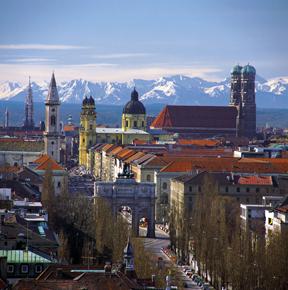
200 Years of German Beer Gardens

Munich, Germany

Photos courtesy Munich Tourist Office

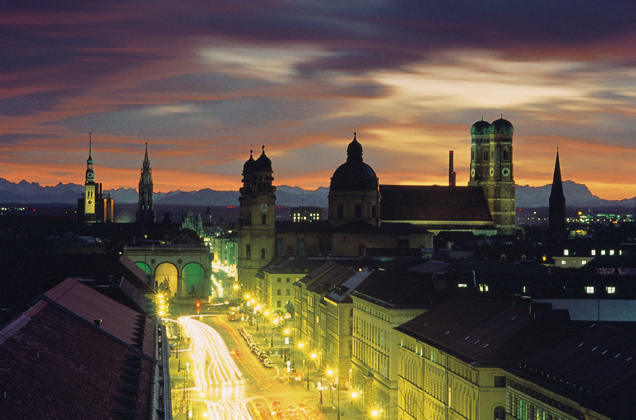
In 2012, Munich and Upper Bavaria are celebrating an old Bavarian tradition. The 200th anniversary of the edict which permitted beer brewers to sell retail quantities of their own beer in their beer cellars from June until September and to serve beer and bread to their guests will be celebrated this year. The city and the breweries of Munich will offer numerous events in local beer gardens.

MUNICH – THE WORLD CITY OF BEER
Big city, high-tech atmosphere mixed with rural charm, art treasures and traditional customs create a very special “Munich mix” which has helped the capital of Bavaria to achieve world renown. But what adds the final touch to the city’s popularity is the drink associated with Munich throughout the world: beer.

BEER GARDEN ETIQUETTE
Bavarian beer gardens fulfill an important social function, as they have always been considered to be a popular meeting point for a wide spectrum of the populace. Visitors should not hesitate to take a seat and start up a conversation with their neighbors at the table. Munich’s beer gardens and the beer gardens in Upper Bavaria are the epitome of Bavarian Gemütlichkeit – the uniquely Bavarian atmosphere of good living, warmth and comfort. And it’s been that way for 200 years.

BRING YOUR OWN FOOD
Bring your own food! A special element of visiting a traditional beer garden in Munich is the fact that guests can bring their own food with them. A perfect Brotzeit, as a beer garden picnic is known, might contain the following: Obazda (a delicious and very Bavarian soft cheese dip), Emmental cheese, radishes, freshly-baked pretzels, butter and salt and pepper. A table cloth is also important (preferably a cotton red and white check), as are wooden boards to eat from, a sharp knife, cutlery and napkins.

But those who come unprepared don’t have to miss out on a Bavarian Brotzeit. Most beer gardens offer a range of typical treats, such as Wurstsalat (finely sliced sausage, dressed with vinaigrette and onions), Leberkäse (Bavarian meat loaf) or Steckerlfisch (barbecued whole fish, normally mackerel).

In a Bavarian beer garden, self-service is the rule, unless it is clear that tables have been readied for service. Typical beer garden drinks, such as beer or Radler (a mix of beer and lemonade or lemon soda), are generally only served in one liter steins. Alcohol-free drinks, such as Spezi (a mixture of cola and orange soda) or Apfelschorle (a mixture of apple juice and mineral water), are normally served in half-liters.

The most important rule when toasting with others at your table is to do it as often as possible, so creating a sense of community and giving you the chance to make contact with your new friends. But don’t forget to look your drinking partners in the eye as you touch steins.
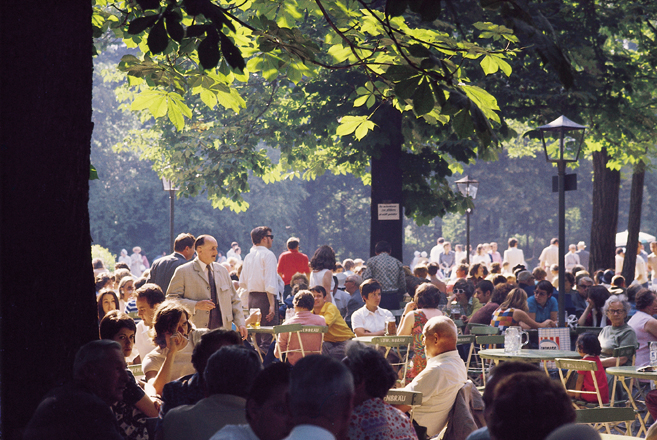
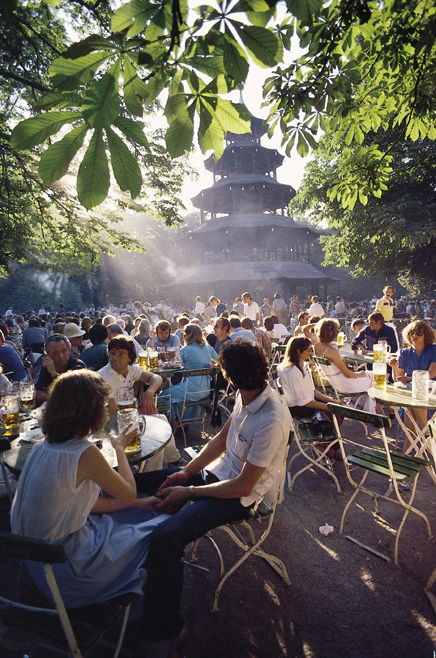
The reason horse chestnut trees can be found in every “real” Bavarian beer garden is a matter of history. According to a decree from the 16th century, brewing beer was banned in the summer months, due to the increased danger of fire. Therefore, beer that was brewed in spring for summer was made with a higher alcohol content to help preserve it. In order to keep the beer cool, beer cellars were constructed close to the breweries, but because Munich has a high groundwater level, deep cellars were out of the question, meaning that those that could be built had to be protected from the sun. And that is why trees which provide a lot of shade, such as horse chestnut trees, were planted above them.

BIER UND OKTOBERFEST MUSEUM, BEER TOURS & MORE
Munich is the capital of beer – with six breweries, the Hofbräuhaus and the Oktoberfest. Interested in the story of beer? How German beer effected the monasteries and the purity law? Why is the quality of Munich’s beer so unique? Did you know that Oktoberfest was established as the national festival for the wedding of King Ludwig I with Princess Therese of Saxe-Hildburghausen? Visit the Bier und Oktoberfest Museum for the answer to these questions and a lot more.

For more info, go to www.muenchen.de

Belfast Launches Titanic Museum

Titanic: Built in Belfast, Celebrated in Belfast

Photos courtesy Tourism Ireland

For the millions of RMS Titanic lovers around the world, April 15 is a very significant date. On that day it will be exactly 100 years since the tragic sinking of the ship that changed so many lives and sparked one of the most captivating stories in human history.

On March 31 the world’s largest Titanic visitor attraction, Titanic Belfast, will officially open its doors, thrusting the ship’s physical and spiritual home firmly into the global spotlight.

The striking $152 million piece of modern architecture stands majestically at the head of the very slipways where the Titanic first glided into the waters of Belfast Lough.

Inside, nine walk-and-ride-through exhibition galleries equipped with the latest 3D, CGI and video technology uncover the true Belfast story of the Titanic, from its conception and construction in the Harland & Wolff Shipyard to its famous maiden voyage and subsequent place in history.

A host of experiences are offered—a thrilling ride through the shipyard with the Titanic under construction, or an exploration of the sumptuous luxury and superb craftsmanship of its interiors.

You can be drawn deep into the stories of the passengers, crew and the heroes of the day or re-live the drama of its tragic end and visit its resting place in the North Atlantic in a unique Ocean Exploration Center with live links to contemporary undersea exploration.

For more info, go to Discover Ireland.

Hike Around Wales on the Wales Coast Path

Consists of 870 miles of trails from soaring cliffs to golden sands

Photos courtesy Visit Britain

The Wales Coast Path creates a complete path along the whole Welsh coastline, and together with the Offa’s Dyke Path, the total route extends to more than 1,000 miles. The Coast Path winds its way through towns and villages, across cliff tops and sandy beaches, sometimes darting inland before emerging at a sheltered cove or tiny hamlet that you would forever miss when traveling by car, bus or train.

The Wales Coast Path has been developed by the Welsh Government in partnership with the Countryside Council for Wales, 16 local authorities and two national parks. In addition to funding from the Welsh Government and the coastal local authorities of approximately $3.15 million per year, the European Regional Development Fund has allocated $6.29 million over four years in support of the project.

Improvements to the quality and alignment of the route will continue during 2012 and 2013 to ensure that the path follows the Welsh coastline as close as it is safe and practical. Over time, the Wales Coast Path is expected to lead to the creation of circular coastal routes as links to inland towns and villages are improved.

Wales is a country blessed with a beautiful coast and stunning scenery. The Wales Coast Path will ensure improved access to the coastline and encourage people to live a healthier and more active lifestyle.

SHAPE OF THE NATION

In the northeast, on the border between Wales and England, the path sets off near Offa’s Dyke, near the coastal town of Prestatyn on the shores of the Irish Sea. This historic dyke is named after the 8th century King Offa, who ordered the dyke be built to separate his kingdom of Mercia from rival kingdoms in what is now Wales. This 177-mile path, forming one of Wales’ three national trails, runs along the Anglo-Wales borderlands. With the development of the coastal path, this will enable visitors to walk around the whole of Wales.

This historical journey continues as the path winds through nearby Conwy with its impressive 13th century castle built by Edward I. The coastal path passes a number of other medieval castles along its way such as Caernarfon, Beaumaris, Criccieth and Harlech in the north, Aberystwyth in mid Wales, and Cardiff and Caldicot in the south. It passes by ancient churches such as St. Hywyn’s in Aberdaron on the Lleyn Peninsula, where since medieval times, pilgrims have come on their way to Bardsey Island, the legendary Isle of 20,000 saints.

All along the coastal path there is breathtaking scenery; places such as Anglesey in the north and Pembrokeshire in the south are especially beautiful. In western Wales, a half mile section of the path recently opened joins the Ceredigion Coast Path with the Pembrokeshire Coast Path National Trail creating a 250-mile unbroken path. Last year, National Geographic voted Pembrokeshire “one of the best coastal destinations in the world, a wonderful part of Wales that must be seen and explored.” There are a variety of beaches along the way, ranging from expansive stretches of sand to tiny sheltered coves.

The wildlife that can be seen while exploring Wales’ coastal path is rich and diverse. Exploration of the coastline along the path reveals bays, headlands, towering cliffs and inlets, all provide stunning views of nesting seabirds, guillemots, razorbills, puffins and shearwaters. Out to sea off the Ceredigion Coast in Cardigan Bay, bottlenose dolphins and porpoises can be seen playing in the surf, and its sheltered inlets and coves harbor Atlantic grey seals basking on the beach or bobbing up and down in the sea.

Wales is famous for its seaside resorts. Among others, the path passes through Tenby in the Southwest, a town steeped in history, renowned as being one of Britain’s finest holiday resorts, and in the north, Llandudno, Wales’ largest resort, a town that has kept its Victorian and Edwardian splendor and boasts two great beaches.

Situated along the coastal path are some of Wales’ finest inns such as the Ty Coch Inn nestled in the tiny fishing village of Porthdinllaen on the north coast of the Lleyn Peninsula, with views across the Irish Sea and with a sandy beach on its doorstep, boasting a fine selection of food and ales.

The number of walkers along the coast is increasing continually, but the path is also suitable for cyclists and horseriding on large stretches and also invites the disabled along its length.

For more info, go to www.visitbritain.com.

Swabia’s Very Own Theme Park

Set deep in the countryside, surrounded by forests and vineyards, Tripsdrill opened in 1929—Germany’s first theme park.

About an hour’s drive southeast of Heidelberg, the park revels in nostalgia, reflecting the Swabian region’s tradition and history. Tripsdrill is set on 190 acres, with 100 one-of-a-kind attractions, including the 100-foot-high “Mammoth” wooden roller coaster. Activities include water sports for the whole family, action rides for thrill seekers and interactive play for children.

In 2012, the Village Street will be enlarged. The new timbered house is typical of Southwest Germany, and its three floors will be devoted to a variety of games for older and also younger children. The year 2012 also marks the 60th birthday of the federal state of Southwest Germany (Baden-Württemberg), and Tripsdrill is joining in the fun with a series of special events to celebrate all aspects of Swabian culture.

The neighboring Wildparadies Tripsdrill (wildlife park) is devoted to wild animals native to Europe. Celebrating its 40th birthday in 2012 with plenty of wildlife action and excursions, this park also has a new feature: overnight stays. Visitors can stay in a shepherds’ wagon or a comfortable treehouse deep in the forest.

For more info, go to www.tripsdrill.de/en

Finding the Black Diamonds

Hunting truffles in the Dordogne

By Marilyn Heimburger
Photos by Don Heimburger

Dining in the Dordogne most certainly brings opportunities to pair wine with the other specialties of the area: foie gras, strawberries, walnuts and truffles.

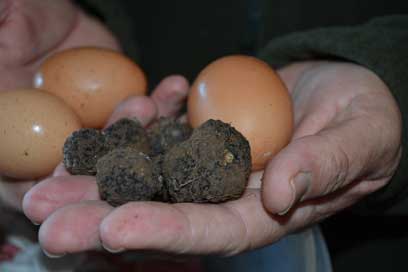
In fact, the Perigord is known for producing the very best black truffle, an aromatic fungus resembling a small black potato. To experience this local treasure, I spent a delightful morning at Truffiere de Pechalifour, the truffle farm of Edouard Aynaud, learning the art of truffle hunting.

Truffle farmer Edouard Aynaud

After meeting the high-energy Edouard, we entered a glass-doored, yellow stone building, where Edouard snaps open the lid of a large plastic bowl holding several black truffles, and thrusts it in my face. “Smell this,” he says in French, insisting that once you have this scent in your head, you’ll never forget it.

Truffle farm
Edouard’s truffle-sniffing border collie

The valuable black truffle, sometimes called the Black Diamond, can command 1,000 Euros per kilogram, since the demand is always greater than the supply. Our host holds up a kiwi-sized truffle and we play “how much is this truffle worth?” My husband wins with his guess of 10 Euros, when the small scale records the truffle’s weight as 10 grams.

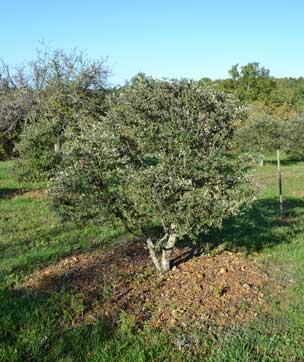
Now the lesson begins: truffles grow at the base of oak and hazelnut trees. The spores of the truffle form a web of mycorrhizal filaments that permeate both the soil and the roots of the trees. These filaments help the trees obtain nutrients from the soil, and in turn, the trees provide the truffle with needed sugars. Once this network spreads, there is a telltale brown circular area around the base of the tree called a “burn.” In the wild, this symbiotic relationship occurs with luck.

Map of truffle "burn"

Here on the 10-acre Pechalifour farm, Edouard’s father planted his first trees in 1968. Today new tree seedlings with truffle spores grafted onto their roots are planted in the hopes of increasing the truffle crop. Edouard holds up a 2-foot-tall oak seedling to illustrate, and tells us that you must plant it and pray, and maybe in several years (3? 6? 10?) the telltale “burn” will appear. He explains that sadly, not many young people are getting into this business because it requires so much patience and optimism.

Edouard, however, personifies optimism and joy, explaining his craft in rapid-fire French (admirably translated by our local guide) and punctuated with animated facial expressions and gestures worthy of Marcel Marceau.

Once the “burn” is identified, there are three methods to locate the truffles beneath it:

  1. With a pig. Grinning, Edouard holds up a Cracker-Jack-toy-sized pink plastic pig to illustrate. Furthermore, he continues, it must be a female pig. Why? Because the truffle scent mimics that of a male pig sex hormone.
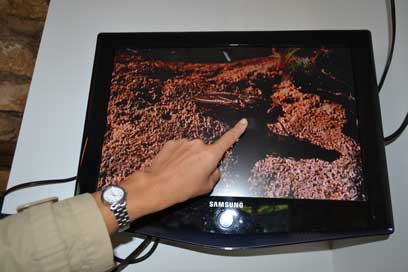
  2. With a stick. Now he whacks a slender willow stick several times across the length of the table. Tapping a stick around the area of the “burn” disturbs a little brown fly that likes to lay its eggs on a ripe truffle, so that its larvae can feed on the nutrients. A short video illustrates that the fly’s brown color renders it invisible at rest. But once disturbed, the fly will rise up and then return to the location of the truffle, which must be harvested before the egg-laying, larva-eating process begins.
  3. With a dog. The dogs must be trained while they are very young to recognize and search for the truffle scent. For that, Edouard uses the plastic film containers used before the age of digital photography. He pokes holes into the container and fills it with cotton that has been moistened with truffle oil. Then for one week he plays fetch with his canine student, rolling the container a little distance away, and rewarding the pup with treats and love when the prize is returned. The next week he hides the container in corners or behind something, and again rewards its return with treats and praise. The third week he buries the container outside under a little bit of soil and waits three days so that it no longer carries his human scent, but only the scent of the truffle, before sending the dog to find it. At the end of three weeks, with lots of praise and treats, the dog is trained.

Suddenly we are aware of a yellow labrador and a young black and white border collie snuffling around our feet, obviously eager to get to work. Edouard grabs a basket, some dog treats and a digging tool, and assuring us that he did not hide truffles ahead of time for us to find, we begin our spirited trek though the trees.

Pointing out brown fly in “burn” area where truffle lie

Walking slightly ahead of us, Edouard sees the telltale “burn” around the base of a tree, and gives his dog the command. Within seconds, the dog sniffs and puts his paw on a spot. Edouard scoops up a handful of the moist soil and sniffs it, crowing gleefully when he detects the scent of the hidden truffle. He pushes into my hands the special two-sided truffle-digging tool: pointed pick at one end, flat scraping blade at the other, and tells me to dig — but gently! We’re not digging up potatoes!

Tree with signs of a truffle underneath

Soon my delicate poking isn’t fast enough for him and he rakes his fingers through the mud until he isolates the prize. After pointing to exactly where I should look, he lets me make the final discovery. Voila! There it is — and it’s tennis-ball HUGE! But, alas, it is spoiled inside because of the recent unfavorable weather. Edouard rewards his dog with a treat and a cuddle, and then crushes the truffle with his fingers and reburies it on the spot, so its spores can sprout again.

The best months for harvesting ripe truffles in the Perigord is December, January and February, and then only if the weather conditions have been favorable — too much rain and they grow too fast and don’t ripen at the right time. All in all, it’s a business that needs luck — and lots of dog treats.
www.truffe-perigord.com