Consists of 870 miles of trails from soaring cliffs to golden sands
Photos courtesy Visit Britain
The Wales Coast Path creates a complete path along the whole Welsh coastline, and together with the Offa’s Dyke Path, the total route extends to more than 1,000 miles. The Coast Path winds its way through towns and villages, across cliff tops and sandy beaches, sometimes darting inland before emerging at a sheltered cove or tiny hamlet that you would forever miss when traveling by car, bus or train.
The Wales Coast Path has been developed by the Welsh Government in partnership with the Countryside Council for Wales, 16 local authorities and two national parks. In addition to funding from the Welsh Government and the coastal local authorities of approximately $3.15 million per year, the European Regional Development Fund has allocated $6.29 million over four years in support of the project.
Improvements to the quality and alignment of the route will continue during 2012 and 2013 to ensure that the path follows the Welsh coastline as close as it is safe and practical. Over time, the Wales Coast Path is expected to lead to the creation of circular coastal routes as links to inland towns and villages are improved.
Wales is a country blessed with a beautiful coast and stunning scenery. The Wales Coast Path will ensure improved access to the coastline and encourage people to live a healthier and more active lifestyle.
SHAPE OF THE NATION
In the northeast, on the border between Wales and England, the path sets off near Offa’s Dyke, near the coastal town of Prestatyn on the shores of the Irish Sea. This historic dyke is named after the 8th century King Offa, who ordered the dyke be built to separate his kingdom of Mercia from rival kingdoms in what is now Wales. This 177-mile path, forming one of Wales’ three national trails, runs along the Anglo-Wales borderlands. With the development of the coastal path, this will enable visitors to walk around the whole of Wales.
This historical journey continues as the path winds through nearby Conwy with its impressive 13th century castle built by Edward I. The coastal path passes a number of other medieval castles along its way such as Caernarfon, Beaumaris, Criccieth and Harlech in the north, Aberystwyth in mid Wales, and Cardiff and Caldicot in the south. It passes by ancient churches such as St. Hywyn’s in Aberdaron on the Lleyn Peninsula, where since medieval times, pilgrims have come on their way to Bardsey Island, the legendary Isle of 20,000 saints.
All along the coastal path there is breathtaking scenery; places such as Anglesey in the north and Pembrokeshire in the south are especially beautiful. In western Wales, a half mile section of the path recently opened joins the Ceredigion Coast Path with the Pembrokeshire Coast Path National Trail creating a 250-mile unbroken path. Last year, National Geographic voted Pembrokeshire “one of the best coastal destinations in the world, a wonderful part of Wales that must be seen and explored.” There are a variety of beaches along the way, ranging from expansive stretches of sand to tiny sheltered coves.
The wildlife that can be seen while exploring Wales’ coastal path is rich and diverse. Exploration of the coastline along the path reveals bays, headlands, towering cliffs and inlets, all provide stunning views of nesting seabirds, guillemots, razorbills, puffins and shearwaters. Out to sea off the Ceredigion Coast in Cardigan Bay, bottlenose dolphins and porpoises can be seen playing in the surf, and its sheltered inlets and coves harbor Atlantic grey seals basking on the beach or bobbing up and down in the sea.
Wales is famous for its seaside resorts. Among others, the path passes through Tenby in the Southwest, a town steeped in history, renowned as being one of Britain’s finest holiday resorts, and in the north, Llandudno, Wales’ largest resort, a town that has kept its Victorian and Edwardian splendor and boasts two great beaches.
Situated along the coastal path are some of Wales’ finest inns such as the Ty Coch Inn nestled in the tiny fishing village of Porthdinllaen on the north coast of the Lleyn Peninsula, with views across the Irish Sea and with a sandy beach on its doorstep, boasting a fine selection of food and ales.
The number of walkers along the coast is increasing continually, but the path is also suitable for cyclists and horseriding on large stretches and also invites the disabled along its length.
Set deep in the countryside, surrounded by forests and vineyards, Tripsdrill opened in 1929—Germany’s first theme park.
About an hour’s drive southeast of Heidelberg, the park revels in nostalgia, reflecting the Swabian region’s tradition and history. Tripsdrill is set on 190 acres, with 100 one-of-a-kind attractions, including the 100-foot-high “Mammoth” wooden roller coaster. Activities include water sports for the whole family, action rides for thrill seekers and interactive play for children.
In 2012, the Village Street will be enlarged. The new timbered house is typical of Southwest Germany, and its three floors will be devoted to a variety of games for older and also younger children. The year 2012 also marks the 60th birthday of the federal state of Southwest Germany (Baden-Württemberg), and Tripsdrill is joining in the fun with a series of special events to celebrate all aspects of Swabian culture.
The neighboring Wildparadies Tripsdrill (wildlife park) is devoted to wild animals native to Europe. Celebrating its 40th birthday in 2012 with plenty of wildlife action and excursions, this park also has a new feature: overnight stays. Visitors can stay in a shepherds’ wagon or a comfortable treehouse deep in the forest.
Dining in the Dordogne most certainly brings opportunities to pair wine with the other specialties of the area: foie gras, strawberries, walnuts and truffles.
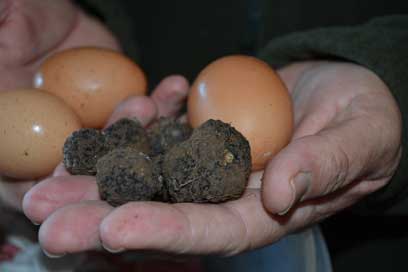
In fact, the Perigord is known for producing the very best black truffle, an aromatic fungus resembling a small black potato. To experience this local treasure, I spent a delightful morning at Truffiere de Pechalifour, the truffle farm of Edouard Aynaud, learning the art of truffle hunting.
Truffle farmer Edouard Aynaud
After meeting the high-energy Edouard, we entered a glass-doored, yellow stone building, where Edouard snaps open the lid of a large plastic bowl holding several black truffles, and thrusts it in my face. “Smell this,” he says in French, insisting that once you have this scent in your head, you’ll never forget it.
Edouard’s truffle-sniffing border collie
The valuable black truffle, sometimes called the Black Diamond, can command 1,000 Euros per kilogram, since the demand is always greater than the supply. Our host holds up a kiwi-sized truffle and we play “how much is this truffle worth?” My husband wins with his guess of 10 Euros, when the small scale records the truffle’s weight as 10 grams.
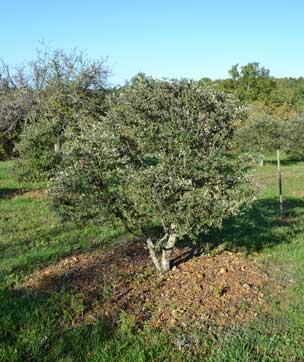
Now the lesson begins: truffles grow at the base of oak and hazelnut trees. The spores of the truffle form a web of mycorrhizal filaments that permeate both the soil and the roots of the trees. These filaments help the trees obtain nutrients from the soil, and in turn, the trees provide the truffle with needed sugars. Once this network spreads, there is a telltale brown circular area around the base of the tree called a “burn.” In the wild, this symbiotic relationship occurs with luck.
Here on the 10-acre Pechalifour farm, Edouard’s father planted his first trees in 1968. Today new tree seedlings with truffle spores grafted onto their roots are planted in the hopes of increasing the truffle crop. Edouard holds up a 2-foot-tall oak seedling to illustrate, and tells us that you must plant it and pray, and maybe in several years (3? 6? 10?) the telltale “burn” will appear. He explains that sadly, not many young people are getting into this business because it requires so much patience and optimism.
Edouard, however, personifies optimism and joy, explaining his craft in rapid-fire French (admirably translated by our local guide) and punctuated with animated facial expressions and gestures worthy of Marcel Marceau.
Once the “burn” is identified, there are three methods to locate the truffles beneath it:
With a pig. Grinning, Edouard holds up a Cracker-Jack-toy-sized pink plastic pig to illustrate. Furthermore, he continues, it must be a female pig. Why? Because the truffle scent mimics that of a male pig sex hormone.
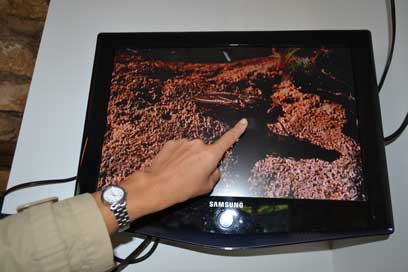
With a stick. Now he whacks a slender willow stick several times across the length of the table. Tapping a stick around the area of the “burn” disturbs a little brown fly that likes to lay its eggs on a ripe truffle, so that its larvae can feed on the nutrients. A short video illustrates that the fly’s brown color renders it invisible at rest. But once disturbed, the fly will rise up and then return to the location of the truffle, which must be harvested before the egg-laying, larva-eating process begins.
With a dog. The dogs must be trained while they are very young to recognize and search for the truffle scent. For that, Edouard uses the plastic film containers used before the age of digital photography. He pokes holes into the container and fills it with cotton that has been moistened with truffle oil. Then for one week he plays fetch with his canine student, rolling the container a little distance away, and rewarding the pup with treats and love when the prize is returned. The next week he hides the container in corners or behind something, and again rewards its return with treats and praise. The third week he buries the container outside under a little bit of soil and waits three days so that it no longer carries his human scent, but only the scent of the truffle, before sending the dog to find it. At the end of three weeks, with lots of praise and treats, the dog is trained.
Suddenly we are aware of a yellow labrador and a young black and white border collie snuffling around our feet, obviously eager to get to work. Edouard grabs a basket, some dog treats and a digging tool, and assuring us that he did not hide truffles ahead of time for us to find, we begin our spirited trek though the trees.
Pointing out brown fly in “burn” area where truffle lie
Walking slightly ahead of us, Edouard sees the telltale “burn” around the base of a tree, and gives his dog the command. Within seconds, the dog sniffs and puts his paw on a spot. Edouard scoops up a handful of the moist soil and sniffs it, crowing gleefully when he detects the scent of the hidden truffle. He pushes into my hands the special two-sided truffle-digging tool: pointed pick at one end, flat scraping blade at the other, and tells me to dig — but gently! We’re not digging up potatoes!
Tree with signs of a truffle underneath
Soon my delicate poking isn’t fast enough for him and he rakes his fingers through the mud until he isolates the prize. After pointing to exactly where I should look, he lets me make the final discovery. Voila! There it is — and it’s tennis-ball HUGE! But, alas, it is spoiled inside because of the recent unfavorable weather. Edouard rewards his dog with a treat and a cuddle, and then crushes the truffle with his fingers and reburies it on the spot, so its spores can sprout again.
The best months for harvesting ripe truffles in the Perigord is December, January and February, and then only if the weather conditions have been favorable — too much rain and they grow too fast and don’t ripen at the right time. All in all, it’s a business that needs luck — and lots of dog treats. www.truffe-perigord.com
Described as the ‘Thuringian Rome,’ it is steeped in history
By Don Heimburger Photos by the author Home page photo by Barbara Neumann, courtesy Erfurt Tourism and Marketing
The reformer Martin Luther once said that Erfurt, Germany “is situated in the best location. It is the perfect place for a city.”
Little did he know 500 years later that Erfurt, the capital of Thuringia, with a population of 200,000 and right in the center of “modern” Germany, would attract large crowds of visitors, many just to see the city in which Luther became an ordained priest.
Erfurt is the capital city of the German state of Thuringia and the main city nearest to the geographical center of modern Germany, located 60 miles southwest of Leipzig. With the Luther Decade ending in 2017, Erfurt has put on its best face to show what is has to offer, and visitors won’t be disappointed.
Erfurt was all spit and polish for the 2015 German Travel Mart in April 2015, when thousands of journalists worldwide, buyers (travel agents and meeting planners) and German suppliers (hotels, Germany’s cities and regions, and commercial attractions) all met in Erfurt (and next-door Weimar) for a three-day-long conference to put Germany on display.
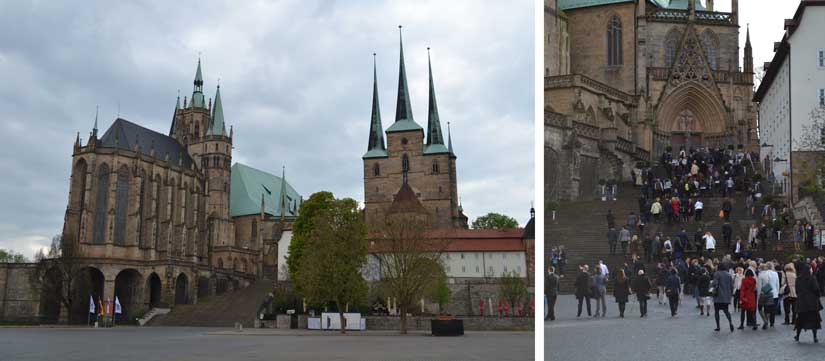
ONE OF LARGEST DOMPLATZ The town’s domplatz is said to be one of Europe’s largest, and it sits next to the impressive central church in Erfurt, St. Mary’s Cathedral, the oldest ecclesiastic building in the city, founded in the 8th century.
Initially the Romanesque-turned-Gothic cathedral served as the bishop’s seat, and up to the 19th century was the seat of the collegiate chapter of St. Mary. Martin Luther himself was ordained in the church in 1507.
The Mariendom (St. Mary’s) and St. Severi form an imposing backdrop for the annual Cathedral Steps Festival held in Erfurt.
The largest free-swinging bell in the world, the “Gloriosa,” with a diameter of 8 feet, hangs in the church today, but because of its age is only rung occasionally. Inside the cathedral there is an elaborate Gothic chancel with a series of 13 colored stained-glass windows which are 42 feet high and are among the greatest works of medieval stained-glass art. The cathedral contains a number of art treasures from various centuries. Guided tours of the church can be arranged in advance.
A flight of 70 steps that lead to the cathedral date back to the 14th century, and today many concerts and events are held on the steps.
Next to St. Mary’s on the hill is St. Severi Church, and together with St. Mary’s the two churches dominate the heart of this medieval city.
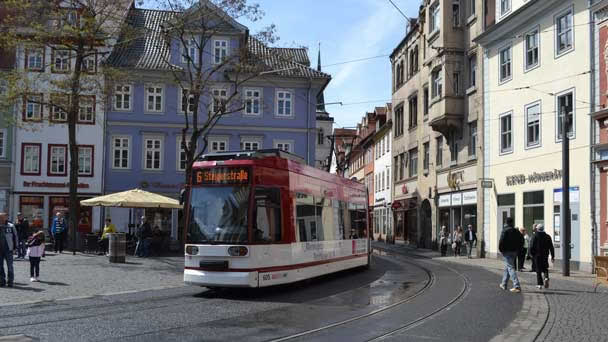
Nicknamed the “Rome of the North” for its profusion of some 30 spires and steeples, Erfurt is unquestionably one of Germany’s most beautiful cities. The old heart of the city with its half-timbered buildings looks like something out of the movies from years ago.
“Erfordia turrita” or “Erfurt, city of towers” is how Luther once praised Erfurt with its 25 parish churches, 15 religious foundations and 10 chapels. This impressive list of ecclesiastical buildings, in conjunction with the magnificent architectural motif of the cathedral and the Church of St. Severus (now the city’s emblem), inspired historians such as Ernst Stida (1585–1632) to refer to the city as the “The Thuringian Rome.”
Most of the churches are still intact and blend in with the beautifully restored half-timbered houses of the Andreas quarter and with the brightly-colored façades of Renaissance buildings. The medieval part of the city is one of the largest and best preserved historical city centers in Germany.
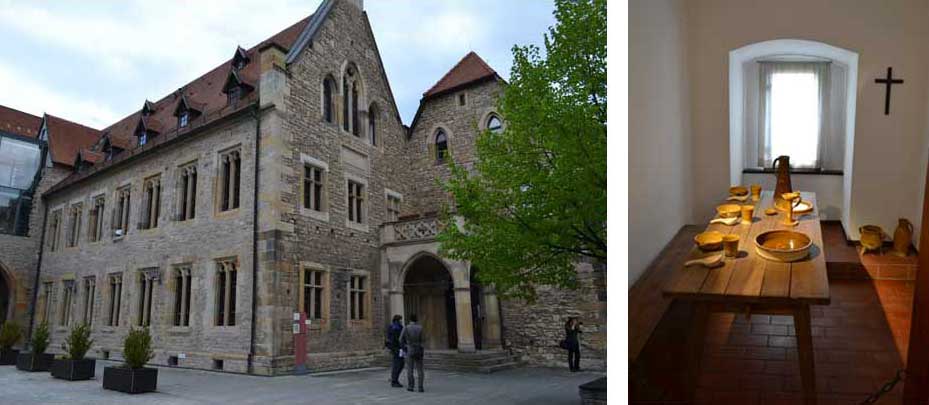
The Augustinian Monastery, built in 1277, is of Gothic design; stained glass windows date from the beginning of the 14th century. The monastery is considered one of the most famous places related to the Reformation.
LUTHER’S MONASTERY In 1505, Luther became a monk and took up residency at the beautiful and peaceful Augustinian Monastery in Erfurt, built in 1277. Recently renovated, the gothic monastery has functioned as an Evangelical/Lutheran church and school since 1525. Visit the chapter house and enjoy the same wonderful acoustics that Luther did in his day, or see the reconstruction of Luther’s cell. The Augustinerkloster possesses valuable stained glass windows dating to the beginning of the 14th century. Martin Luther lived here as a monk from 1505 to 1511. You can also spend the night in one of the 51 comfortable guest rooms at the monastery. Today the abbey serves as an ecumenical conference center and a memorial to Luther.
The Luther Stone stands to the east of Stotternheim near Erfurt. On July 2, 1505 Martin Luther, then a law student at Erfurt University, was returning to Erfurt after visiting his parents in Mansfeld. He was making the journey on foot, and as he approached Stotternheim he witnessed a severe thunderstorm that put him in fear of his life. He is said to have cried out, “Help, St. Anne, I will become a monk.” The site where the memorial stone now stands is sometimes described as the birthplace of the Reformation.
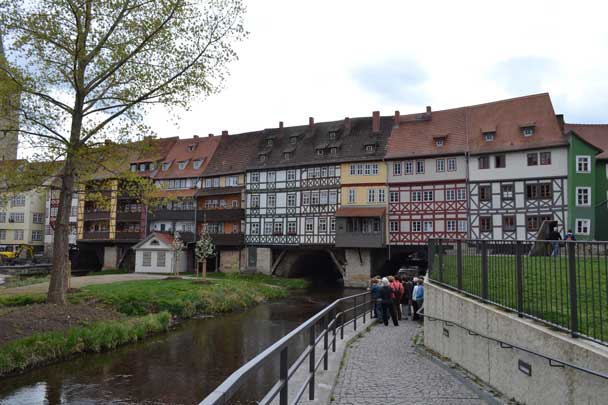
Merchant’s Bridge, a landmark in Erfurt, is the longest bridge in Europe covered by houses that are still inhabited today. In early times, traders sold their wares from this unique bridge.
The Krämerbrücke/Merchants’ Bridge is Erfurt’s most interesting example of secular architecture. This arched stone bridge was constructed in 1325 over the river Gera where the original ford was located along the “via regia” trading route. The Krämerbrücke is the only bridge north of the Alps to be built over entirely with houses that are still used as residences. In medieval times there were two churches built at each end of the bridge, one of which, the Ägidienkirche, is still in existence.
In 1695, the first foundation stone was laid for one of the few remaining 17th century city fortifications to be found in Germany. Today the Petersberg Citadel is an impressive example of European fortification construction dating from the 17th to the 19th centuries. Parts of the fortification were open to the public in 1964, but after 1990 it was extensively renovated, and today the greater part of the casemates, esplanades and bastions inside the fortification area are open to visitors. The completion of the citadel and the Petersberg are Erfurt’s largest undertaking.
(left to right) The Erfurt Rathaus is located at the Fischmarkt; origins of the building go back to the 11th century.; Erfurt city guide Matthias Gose points out aspects of the town on a scale model cast in metal.; Erfurt architecture
Haus zum Breiten Herd, historic Renaissance guild house, Fischmarkt square, Erfurt. In earlier times, rich merchants of the the city decorated the fronts of their homes with delicate carvings.
The neo-Gothic town hall at the Fischmarkt was built between 1870 and 1874. Inside the stairwells and the Festsaal (main function hall) there are numerous wall paintings depicting legends and scenes from the life of Luther, as well as pictures illustrating the history of Thuringia and Erfurt.
Erfurt city guide Matthias Gose points out aspects of the town on a scale model cast in metal
The Old Synagogue is one of very few preserved medieval synagogues in Europe. Thanks to the extensive preservation of the original structure, it has a special place in the history of art and architecture and is among the most impressive and highly rated architectural monuments in Erfurt and Thuringia. The synagogue was constructed during the Middle Ages on the “via regia,” at the heart of the historical old quarter very close to the Merchants Bridge and the town hall.
Many parts of the structure still remain today, including all four thick outer walls, the Romanesque gemel window, the Gothic rose window and the entrance to the synagogue room. After extensive restoration, the building was reopened in 2009. On display in the exhibition rooms is a collection of medieval treasures discovered during archaeological excavations. This includes 3,140 silver coins, 14 silver ingots, approximately 6,000 works of goldsmithery from the 13th and 14th centuries, and an intricate wedding ring of the period, of which only two others are known to exist in the world.
One of the buildings that reflects the history of Erfurt in a special and unique manner is the Kaisersaal in the Futterstrasse, which, after radical reconstruction, was reopened in 1994. It was built out of three patrician houses at the beginning of the 18th century to serve as the university’s ballroom. It is the oldest center for cultural events and meetings in Germany.
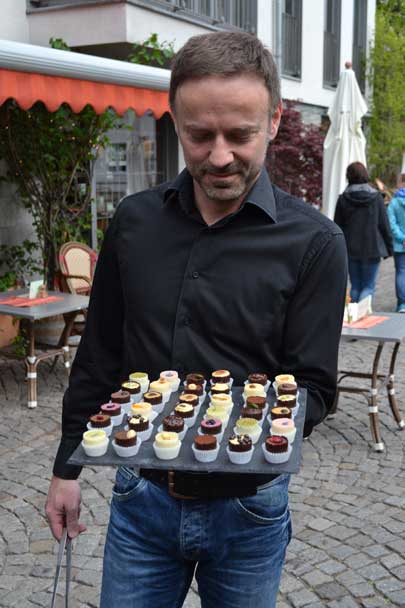
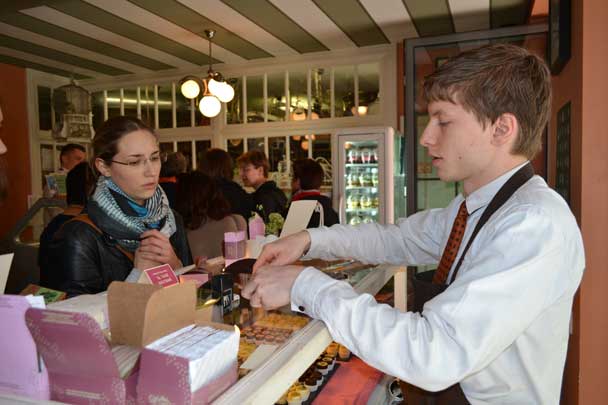
The Goldhelm Schokolade shop in Erfurt provides a selection of fresh chocolates every day
The Anger Museum with its variety of wood and stone sculptures is situated in the middle of the old part of the city. It was built between 1706 and 1712 as a packing and weighing station, both for Philipp Wilhelm Reichsgraf von Boineburg, the governor of the city, and for Archbishop Lothar Franz von Schönborn. It is one of the most important early 18th century buildings.
The Erfurt city museum, in the magnificent Haus zum Stockfisch building, was founded in 1886 to house the artworks that Erfurt inherited from one of its most famous sons, the Romantic painter Friedrich Nerly. The museum’s four floors present the city’s culture, economic development, politics and religion.
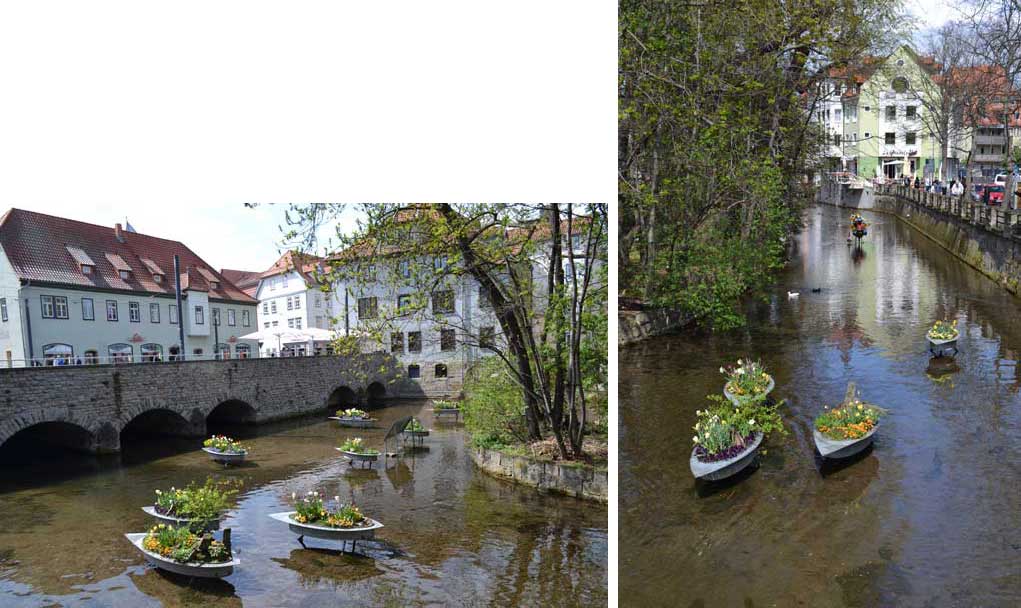
Flowers decorate the Gera River channels in Erfurt.
Erfurt’s last water mill to still be in use is located on the banks of the Gera River near the town hall. Besides the water-driven grinding mill, there are also exhibition rooms displaying historical machines. The museum also contains an illustrated history of Erfurt’s water mills in particular and of the history of hydraulic power in general.
Erfurt, said to be Germany’s largest single heritage site, is a popular destination for tourists, thanks to its medieval ambiance and storied history.
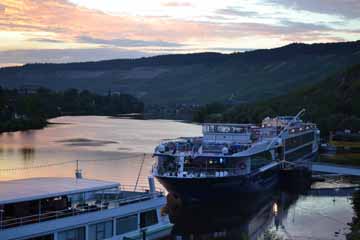
Are you are looking for a vacation that combines relaxation, a bit of history, romantic castles, charming medieval villages, and excellent cuisine? This week-long river cruise on the Moselle, Rhine and Main rivers in Germany, offered by Avalon Waterways, may be the perfect choice for you.
The MS Avalon Luminary, our ship for this cruise, was just recently added to Avalon’s fleet. Its 69 staterooms and suites are designed for efficiency, with plenty of space to stow personal items and luggage. Each room had a small bathroom with shower, comfortable memory foam mattress, a desk, lamp, mirror, fresh flowers, mini bar, and a safe for valuables. A television provided satellite programming and broadcast the view from a camera at the front of the ship. Floor-to-ceiling windows open to a private balcony in most rooms. It’s a luxury of river cruising to just unpack once and let the ship transport you with ease to each destination.
Another luxury on a cruise such as this is the excellent cuisine. The sumptuous breakfast buffet included breads, pastries and cereals, fruits, eggs, potatoes, sausages and bacon, and made-to-order entrees. The full lunch buffet served each day in the main dining room offered soups, salads, choice of main course and desserts. A lighter lunch option was also available in the lounge one deck above. Five-course dinners included an appetizer, choice of soups, salad, choice of meat, fish or vegetarian main course, and several dessert options. The well-trained staff served red, rose, or white wine or beer upon request.
BOARD IN LUXEMBOURG Boarding the Luminary in Remich, Luxembourg, we were welcomed by cruise director Jean Loup Domart. Entertaining, energetic, and extremely organized, Jean excelled at keeping everything running smoothly.
Although we set sail while dinner was being served, we missed none of the excitement, since the dining room was designed for maximum viewing, with panoramic windows on both sides. A sense of intimacy was provided with fresh orchids in lighted open rectangles dividing the large space without interrupting with the view. The lounge on the level directly above the dining room was also designed for watching Germany glide by in the most comfortable of settings.
Our first stop was Trier, Germany, which boasts amazingly intact structures from the Roman Empire, including imperial baths, an amphitheater, and Constantine’s reception hall, which now serves as a protestant church. Did you ever wonder why Roman ruins always seem to be discovered 6 feet underground? We learned from our local guide that after Roman towns were abandoned, local residents built homes by taking usable stones from the old Roman buildings. Over the course of 600 years, this practice left a 6-foot-deep base of rubble, upon which the medieval towns were built. Trier’s Porta Nigra (black gate) is black from wood fire smoke from Roman times, and was left standing because it was a site that attracted pilgrims, who brought money to the church.
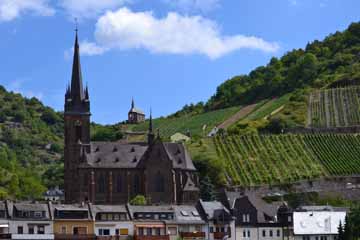
As our trip continued down the Moselle, we passed vineyard after vineyard and peaceful patchwork slopes, dotted with small villages and church steeples. The southern facing slopes provide the perfect environment for catching warm sunlight needed to grow grapes for Germany’s famous Riesling wines. And the ship’s outdoor decks were perfect for relaxing with a cup of coffee or listening to birds along the shore as the ship glided quietly along.
BERNKASTEL-KUES WEINFEST Our late afternoon arrival in Bernkastel-Kues allowed just enough time to explore the Old Town around the quaint market square. This town hosts the biggest Weinfest on the Moselle in September. One vineyard overlooking the town is the source of their “Doktor” wine. Legend has it that drinking some of the wine from this vineyard cured an archbishop of an ailment, so the wine became known as the “Doktor.”
Half-timbered buildings in Bernkastel
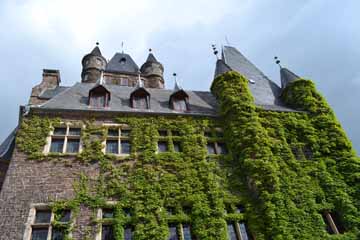
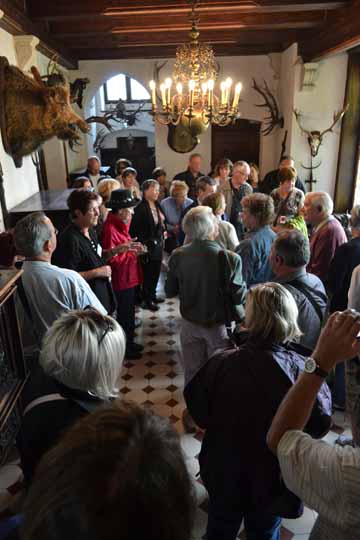
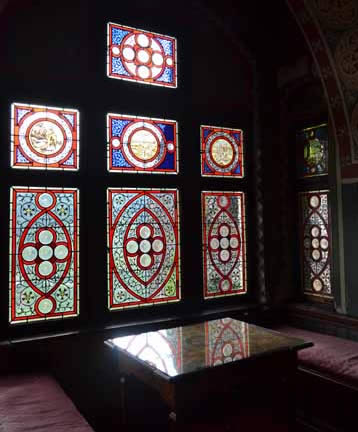
The next day brought us to the wine town of Cochem and a tour of Reichsburg Castle. The interior of the castle highlights not only only medieval artifacts, but Renaissance and Baroque furnishings selected by the 19th century restorers. The tour was informative and the view from the castle — spectacular.
Passengers tour the castle
The Moselle joins the Rhine at Koblenz, an important center of trade during the Middle Ages. An imposing statue of Kaiser Wilhelm I mounted on a horse dominates the Deutches Eck (German Corner) where the two rivers meet. We arrived just before dinner, with enough time for a short walk into the square to see the many shops and restaurants. The fortress Ehrenbreitstein stands on the opposite bank of the river and provides a beautiful panoramic view of the area.
To begin our cruise down the Rhine Gorge (some say the most beautiful part of the Rhine) first thing in the morning, we docked overnight at Koblenz, and were entertained on board after dinner by a small ensemble of classical musicians.
THE MIDDLE RHINE The next morning was filled with the history, legends and romance of the Middle Rhine. Cruise Director Jean Loup provided informative narration as the ship glided along, with passengers enjoying the view while relaxing on the sundeck. We learned that during the Middle Ages the Rhine River Gorge posed many hazards for travelers, and provided many opportunities for powerful kings to levy tolls for safe passage. They built castles and fortresses in the 12th and 13th centuries along the banks to collect tolls, make money, and enlarge territories.
Reichsburg Castle
The castles were usually built high on hills, close to a spring, and often on a curve with a view of the river. Stones for the castles were lifted with wheels and ropes, and the building projects provided work and security for locals, whose lifespan at the time was only about 40 years. Most castles were built with limestone, which was easier to work with than granite. Later palaces were built with marble, as techniques improved. To attack a fortress, enemies could try to break down a wall or door with a battering ram on wheels with a roof as protection from arrows shot from the castle. Or a catapult could throw fire over the castle walls. Castles residents used beehives, hot tar or hot water to fend off attackers. Some fortresses housed armies of 600.
In the town of Boppard we saw Sterrenberg and Liebenstein, known as the castles of the enemy brothers, and heard the legend: Two brothers both fell in love with their adopted sister. She wanted none of this, and entered a monastery in town to live as a nun. The brothers fought and finally built two castles next to each other with a wall in between.
The 430-foot-high Lorelei rock is located where the river narrows, creating treacherous currents dangerous to ships. The famous legend of the beautiful maiden who sat on the rock luring sailors to their destruction with her singing is commemorated with a bronze statue.
The town of Oberwesel, below Schoenburg Castle, still has many fortification walls and towers still standing. When the river water is low, travelers can see the “rocks of the seven virgins.” Legend has it that a lord with seven sons wanted to arrange marriages for them. The seven chosen virgins didn’t want to marry, and threw themselves into the Rhine, where, because they were so hardhearted, they turned to stone.
Pfalz Castle (whose gold lion was to symbolize strength and power) was built in the 16-17th century as a customs tollhouse on a little island in the middle of the river. Gutenfels Fortress was built on the bank opposite Oberwesel to protect the tollhouse.
Sooneck Castle, a toll-enforcing castle from the 11th century, also housed pirates. It is one of the oldest along the Rhine and is restored as a cafe.
In an attempt to preserve the beauty and tranquility of the shoreline, many of the houses along the shore are painted in soft pastels, often pale yellow, a color made popular by Maria Theresa. Train tunnel entrances on this stretch of the river are built to look like castles, in order to blend in with the style of the area.
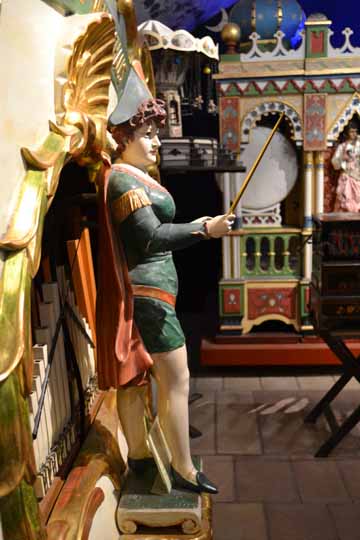
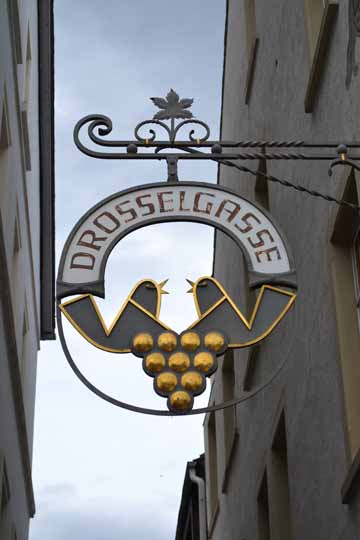
(left to right) Siegfried’s Mechanical Musical Instrument Museum; Drosselgasse, a lively street in Rudesheim.
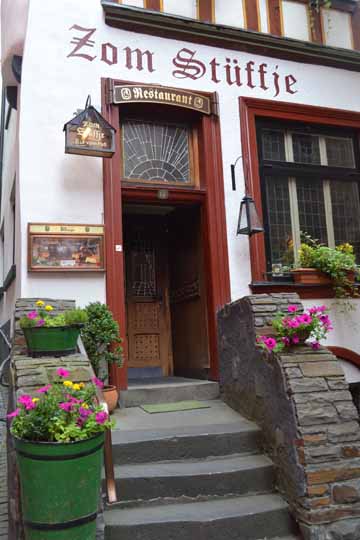
DROSSELGASSE A FAVORITE Our last stop on the Rhine River was in Rudesheim, where we enjoyed a guided tour of the Museum of Mechanical Musical Instruments (some imitating entire orchestras in one huge contraption!), and a local winery. Be sure to take time to explore the exciting main street, the Drosselgasse, with its many restaurants and shops.
Navigating the Main River is a slow process because of the many locks needed to raise or lower the ship along the route. So our ever resourceful cruise director kept passengers busy on board with an entertaining German lesson, and a cookie-baking demonstration by an “almost nun” from Miltenberg, our next port of call on the Main.
Miltenberg
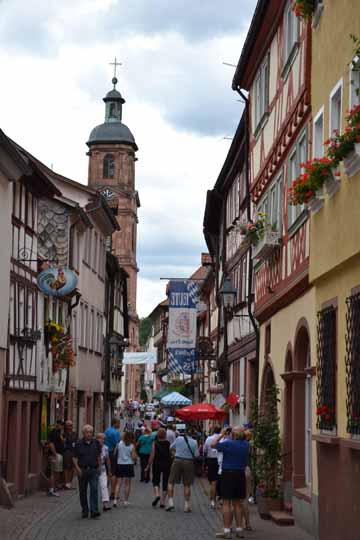
Miltenberg was built against a hill at a curve in the river, a perfect place to collect tolls for the archbishop of Mainz. Many half-timbered houses are still preserved because the people here were too poor to tear them down and rebuild. If a floor sagged and sank, it was filled with sand and covered with another floor. In some recently renovated buildings, 30 centimeters of sand/wood layers were discovered beneath the floor. The original red “paint” on the houses was a mixture containing, among other things, oxblood and cattle dung, which provided the desired red color and also killed worms that might live in the wood. A unique naturally cool icehouse is located in the hill at the rear of the town.
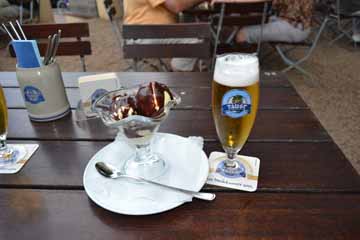
Cold beer and ice cream
While the ship slowly navigated through more locks, passengers rode by bus to Wurzburg, and met the ship when it finally docked after our tour. Wurzburg is the site of the Prince Bishop’s Residenz, which is one of the finest examples of a baroque palace, and also a UNESCO World Heritage Site. It was built to rival Versailles in France and the Schoenbrunn in Vienna. The unique mirrored room features the difficult technique of reverse painting. The famous ceiling fresco by Tiepolo miraculously survived bombing, and the original marble floor is still in the main reception hall. The “marble” pillars are actually a stone core with a ground marble coating so that colors could be controlled, a technique that was more expensive than using solid marble.
Wurzburg
WURZBURG AND X-RAYS Wurzburg was also the home of Professor William Conrad Rundkin, winner of the Nobel Prize for the discovery of X-rays. Residents in Wurzburg are not x-rayed; they are “Rundkined.”
Bamberg
The terrain along the river from Wurzburg to Bamberg changes and becomes flatter, with fewer vineyards, more trees and shrubs, and more locks. This quiet time was perfect for relaxing with a book from the ship’s library, located in the small lounge at the rear of the ship. There passengers found English language books of all genres, games, and the most wonderful coffee machine which dispensed espresso drinks that rivaled any coffee shop. Iced tea, shortbread cookies and other snacks were available 24/7. The ship also had an exercise room with a treadmill, two types of exercycles and flat screen TV, and a small beauty salon.
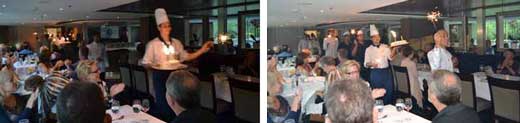
Cruise ship surprises
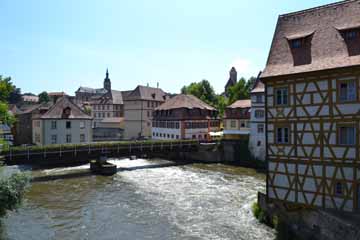
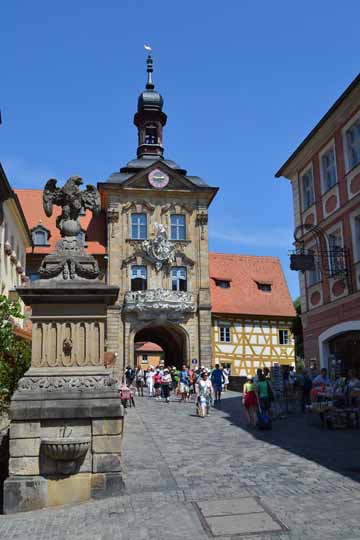
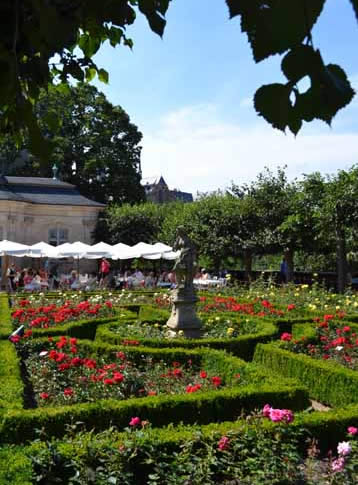
Busses again transported us to meet local tour guides in Bamberg, another UNESCO World Heritage Site. There we learned the local history of the cathedral, the Old Town Hall, which straddles the River Regnitz, had an opportunity to taste the local specialty, “Rauchbier” (smoked beer), and had time for browsing in the main pedestrian shopping area.
Our cruise ended the next morning upon arrival in Nuremberg, from which some passengers continued by bus to Prague, and others to charming Rothenburg ob der Tauber.
IF YOU GO.. Avalon Waterways, which has been in business for 80 years, has a number of different river cruises available in Europe. Their river cruise ships are small compared to ocean liners, which makes the service and trip more personal. They also have Europe’s youngest fleet of ships, with their fleet averaging just two years old, compared to seven years for other cruise companies.
There are full floor to ceiling sliding glass doors in 85% of the deluxe staterooms on Avalon’s fleet. Also, the Luminary had lots of space in the central passenger areas such as the dining room, lounge and library.
The Luminary offered five categories of rooms including Royal Deck suites; Royal Deck Category P; Sapphire Deck Forward, Category A; Sapphire Deck Aft, Category B; and Indigo Deck, Category E.


















 European Traveler