Photos courtesy Lake Geneva Office of Tourism, Switzerland
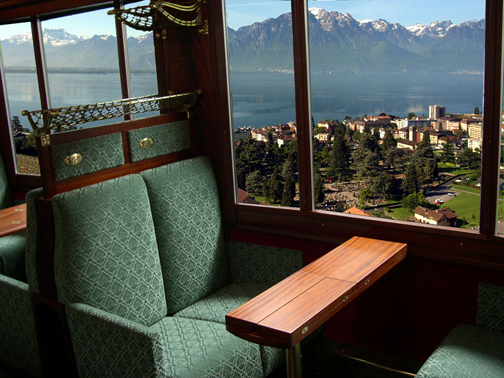
The GoldenPass Cheese Train in Switzerland will take you from Montreux to Château-d’Oex every Friday, Saturday and Sunday at 10:30 a.m. through April 27, where you can discover the specialities of the Pays-d’Enhaut region.
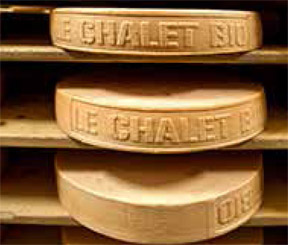
CHEESEMAKING DEMONSTRATION
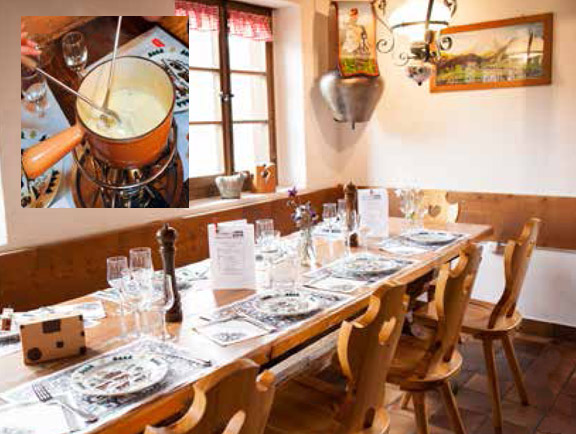
Le Chalet is a typical mountain chalet, serving fondue and dessert.
MUSÉE DU VIEUX PAYS-D’ENHAUT (SILHOUETTE MUSUEM) This museum of folk art was established in 1922 and gives an insight into the lives of the Swiss forefathers. The museum is well-known in particular for its collection of over 60 well-preserved scissor-cut silhouettes.
The art of paper cutting produces images that look like lace. They are carefully cut with scissors or cutters and are traditionally produced in one piece, in black and white. A paper cutting may also have different shades of color or formats, and sometimes it looks like a collage of colored papers.
Also in the Folk Art Museum there is painted wooden furniture, sculptures, statues, military paraphernalia, cow bells and skis, all from the XIV century. These objects are displayed throughout 15 individual rooms. The museum has also recreated rooms which depict the life of blacksmiths, alpine cheese-makers, country kitchens and a bread oven which dates back to 1665.
Switzerland is a hiking paradise, especially in fall, when the trees turn colors, the light is magical and the views most clear. With more than 37,300 miles of marked footpaths, 9,300 miles of cycle routes and mountain bike trails as well as charming canoe trips on lakes, outdoor activities are easily accessible to all.
Switzerland has integrated its outdoor trails into a single network: Switzerland Mobility. Thanks to high quality trails, all clearly marked, you can explore Alpine peaks, rolling hills, traditional villages and historic towns in delightful backdrops all by yourself.
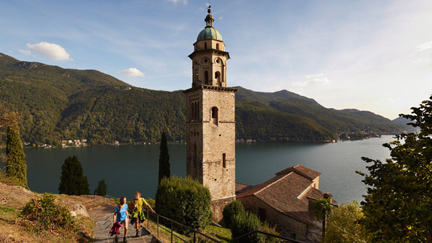
FOUR SCENIC STAGES FROM BELLINZONA TO MENDRISIO If you are looking for a hike through the sunny, southernmost canton of Switzerland, called the Ticino Canton, the section from Bellinzona to Mendrisio of the Trans Swiss Trail includes four scenic stages, passing through glades of ferns and forests of birch, by pretty lakes and over panoramic peaks.
1ST DAY: BELLINZONA–TESSERETE (12.5 MILES) Bellinzona’s three castles, which became a UNESCO World Heritage Site in 2000, make a fine backdrop for the start of this hike, which begins with a dramatic climb of 2,300 vertical feet until you are high above the Magadino plain. The trail then drops into the Val d’Isone and climbs the other side to the former lake of Gola di Lago, now just a marsh. You continue through glades of ferns and thin birch woods towards Monte Bigorio and then down to Tesserete, passing Switzerland’s oldest Capuchin monastery: Santa Maria, occupying a heavenly position high above the surrounding villages.
2ND DAY: TESSERETE–LUGANO (5.5 MILES) The trail continues along a thickly wooded ridge until the chapel of San Bernardo, where it reveals spectacular views over Lugano and its lake, draped between the surrounding hillsides. You experience Lugano’s Mediterranean charm down in the city center, especially on warm summer evenings, when people gather in the outdoor cafes and along the lakefront to chat, stroll, celebrate and relax in style.
3RD DAY: LUGANO–MORCOTE (8.5 MILES) The funicular ride up San Salvatore, a climb of 2,000 vertical feet, starts your day. The walk onward to Vico Morcote is a classic, ideal for all the family. The spectacular trail falls gently as it passes in and out of woodland and through pretty villages. All along the way, you’re never far from the next “grotto” (traditional Ticino restaurant).
4TH DAY: MORCOTE–MENDRISIO (8 MILES) The day starts gently with a romantic boat ride across the lake from Morcote to Terniciolo, and the UNESCO World Heritage Site of Monte San Giorgio. The mountain is famous around the world for its fossils: see some of the finest at the new museum in Meride.
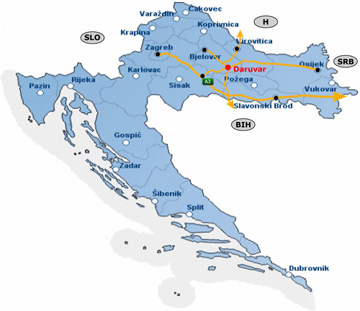
Daruvar in Hungarian means Crane town (daru=crane, var=town).
HISTORY On February 28, 1765 Maria Theresa, Queen of Habsburg dominions, granted Count Jankovich the title “de Daruvar” because of the crane in his family’s coat of arms. When Antun Jankovich built the Daruvar Castle between 1771 and 1777 the town was forever known as Daruvar (in Hungarian “Daruvar” means Crane town or Crane’s castle).
The crane’s pose on the coat of arms, turned to the right side with its leg raised, represents constant alert on the watch. Since Antun Jankovich was the founder of the town, the symbol on the town’s coat of arms is also a crane.
MOST DECORATED SMALL TOWN OF CONTINENTAL CROATIA The combination of greenery and urban architecture, cultural diversity and fertile vineyards, entices travelers to visit Daruvar.
Famous as a spa town with the tradition of health tourism for more than 2,000 years, the town boasts an enriched combination of greenery, new and historic buildings and a rich selection of touristic and recreational facilities.
WINE ROAD The Daruvar Wine Road and recreational areas which are located within the newly-opened thermal water park “Aquae Balissae” make the town an interesting place to visit for many local and foreign visitors. Two large decorated parks and the Roman forest in the town center discreetly blend with the town’s architecture, making the town one of the greenest urban areas in Croatia.
By Danielle Pruger Photos courtesy of Castilla-León Regional Tourist Board
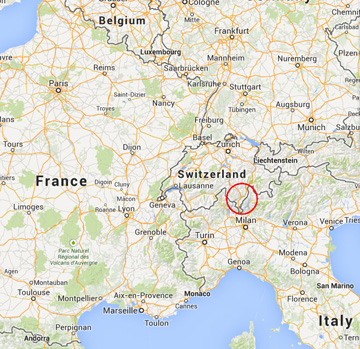
Castile-Léon Spain is highlighted in red.
Castile-Léon, an interior region of Spain, is known for its castles (Castile means “land of castles” in Spanish) and provides a look at ancient and medieval forms of architecture. Throughout the Middle Ages, Castile-Léon served as a frontier between Christians and Muslims from the 9th century to the 11th century, which created the initial motivation for building fortresses and castles. Later, the struggle between the various noble families and the royal family from the 12th century to the 15th century made it necessary to build new fortifications. The following six castles, open to the public, can be found in Castile-Léon.
AMPUDIA CASTLE The municipality of Ampudia is home to a 15th century castle which stands in the center of the village. This castle is well preserved and has been restored. Its sturdy enclosure is protected by four towers, and it has all of the traditional elements of medieval castles: battlements, ramparts, barbicans and a moat. Although it is privately owned, it is open to visitors, and its interior is home to a museum of art and antiquity.
PEÑAFIEL CASTLE The medieval castle in Peñafiel was built in the 11th century and stands on a rocky spur. The castle was rebuilt around the 14th and 15th centuries and has a peculiar shape because the outline of the walled enclosure conforms to the elongated silhouette of the ridge. This unusual shape has made it one of Spain’s most famous images; from a distance the castle resembles a boat run aground in the midst of a sea of pastures and wheat fields. This castle is also home to the Provincial Wine Museum.
ALCÁZAR FORTRESS The city of Segovia contains the Alcázar fortress, another one of Spain’s most emblematic images. This imposing Gothic building was built between the 14th and 15th centuries and was later transformed by Philip II in the 16th century into the Herrerrian style seen today. It was the residence of the Castilian and Spanish monarchs for two centuries; its location is on a gorge above the Eresma and Clamores rivers. The location, along with the appearance of the castle, is similar to the castles in fairytales, which evoke the images of princesses, knights, witches and dragons.
COCA CASTLE The Coca Castle, located in the municipality of Coca, is completely different from other castles; it was built in the Mudejar style of the 15th century using typical red brick. It has three walled enclosures, a moat with a drawbridge, a bailey (courtyard) and a splendid keep. The village of Coca is the descendant of the Celtic-Iberian city of Cauca, which was conquered by the Romans in 151 B.C.
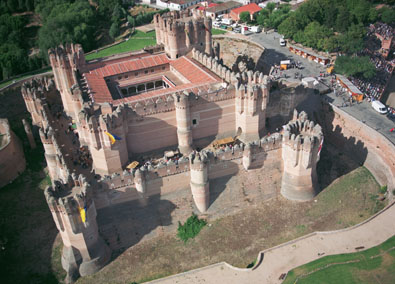
LA MOTA CASTLE La Mota Castle, also designed in the Mudejar style, is located in the town of Medina del Campo. It was built in the 15th century using concrete and red brick and has four enclosures protected by enormous walls, as well as a monumental keep. It was in the 15th century that Medina del Campo reached its maximum splendor: its fairs were the most important in all of Europe, and it is where bills, instead of coins, were first used as currency. This is also the place where Queen Isabella I of Castile, known as Isabella “la Católica,” died.
Zamora Castle
ZAMORA CASTLE The city of Zamora, located beside the Duero River, has a medieval castle that was built in the 12th century. This castle was restored in 2009, and the castle is surrounded by three walled enclosures dating from the same period, which encircle the historic center of town.
Austria is a magnificent country that offers plenty of tourist attractions. One popular attraction is located in Werfen, Austria which is home to “Eisriesenwelt,” German for “world of the ice giants.”
Eisriesenwelt was discovered in 1879 by a scientist named Anton Posselt and is located inside of the Tennengebirge section of the Alps. Prior to Posselt’s discovery in 1879, hunters and poachers knew of its existence, but had never entered the cave. Although Posselt only explored 1/8 of a mile inside the cave, he published a report of his discovery a year later. It wasn’t until 1921 that Eisriesenwelt saw a large increase in the number of visitors to the cave.
Lamps are distributed to visitors who explore these breathtaking caves for a 75 minute tour. Visitors experience Posselt Hall, which holds the Posselt Tower stalagmite; the Great Ice Embankment, a formation towering over 75 feet; and the Ice Organ, created by the stalactites in Hymir’s Castle. The ice formations are sometimes highlighted with magnesium lighting for an added effect.
The Eisriesenwelt caves are open from May 1 to October 26, and during peak season tours are held every six minutes.