For the millions of RMS Titanic lovers around the world, April 15 is a very significant date. On that day it will be exactly 100 years since the tragic sinking of the ship that changed so many lives and sparked one of the most captivating stories in human history.
On March 31 the world’s largest Titanic visitor attraction, Titanic Belfast, will officially open its doors, thrusting the ship’s physical and spiritual home firmly into the global spotlight.
The striking $152 million piece of modern architecture stands majestically at the head of the very slipways where the Titanic first glided into the waters of Belfast Lough.
Inside, nine walk-and-ride-through exhibition galleries equipped with the latest 3D, CGI and video technology uncover the true Belfast story of the Titanic, from its conception and construction in the Harland & Wolff Shipyard to its famous maiden voyage and subsequent place in history.
A host of experiences are offered—a thrilling ride through the shipyard with the Titanic under construction, or an exploration of the sumptuous luxury and superb craftsmanship of its interiors.
You can be drawn deep into the stories of the passengers, crew and the heroes of the day or re-live the drama of its tragic end and visit its resting place in the North Atlantic in a unique Ocean Exploration Center with live links to contemporary undersea exploration.
Consists of 870 miles of trails from soaring cliffs to golden sands
Photos courtesy Visit Britain
The Wales Coast Path creates a complete path along the whole Welsh coastline, and together with the Offa’s Dyke Path, the total route extends to more than 1,000 miles. The Coast Path winds its way through towns and villages, across cliff tops and sandy beaches, sometimes darting inland before emerging at a sheltered cove or tiny hamlet that you would forever miss when traveling by car, bus or train.
The Wales Coast Path has been developed by the Welsh Government in partnership with the Countryside Council for Wales, 16 local authorities and two national parks. In addition to funding from the Welsh Government and the coastal local authorities of approximately $3.15 million per year, the European Regional Development Fund has allocated $6.29 million over four years in support of the project.
Improvements to the quality and alignment of the route will continue during 2012 and 2013 to ensure that the path follows the Welsh coastline as close as it is safe and practical. Over time, the Wales Coast Path is expected to lead to the creation of circular coastal routes as links to inland towns and villages are improved.
Wales is a country blessed with a beautiful coast and stunning scenery. The Wales Coast Path will ensure improved access to the coastline and encourage people to live a healthier and more active lifestyle.
SHAPE OF THE NATION
In the northeast, on the border between Wales and England, the path sets off near Offa’s Dyke, near the coastal town of Prestatyn on the shores of the Irish Sea. This historic dyke is named after the 8th century King Offa, who ordered the dyke be built to separate his kingdom of Mercia from rival kingdoms in what is now Wales. This 177-mile path, forming one of Wales’ three national trails, runs along the Anglo-Wales borderlands. With the development of the coastal path, this will enable visitors to walk around the whole of Wales.
This historical journey continues as the path winds through nearby Conwy with its impressive 13th century castle built by Edward I. The coastal path passes a number of other medieval castles along its way such as Caernarfon, Beaumaris, Criccieth and Harlech in the north, Aberystwyth in mid Wales, and Cardiff and Caldicot in the south. It passes by ancient churches such as St. Hywyn’s in Aberdaron on the Lleyn Peninsula, where since medieval times, pilgrims have come on their way to Bardsey Island, the legendary Isle of 20,000 saints.
All along the coastal path there is breathtaking scenery; places such as Anglesey in the north and Pembrokeshire in the south are especially beautiful. In western Wales, a half mile section of the path recently opened joins the Ceredigion Coast Path with the Pembrokeshire Coast Path National Trail creating a 250-mile unbroken path. Last year, National Geographic voted Pembrokeshire “one of the best coastal destinations in the world, a wonderful part of Wales that must be seen and explored.” There are a variety of beaches along the way, ranging from expansive stretches of sand to tiny sheltered coves.
The wildlife that can be seen while exploring Wales’ coastal path is rich and diverse. Exploration of the coastline along the path reveals bays, headlands, towering cliffs and inlets, all provide stunning views of nesting seabirds, guillemots, razorbills, puffins and shearwaters. Out to sea off the Ceredigion Coast in Cardigan Bay, bottlenose dolphins and porpoises can be seen playing in the surf, and its sheltered inlets and coves harbor Atlantic grey seals basking on the beach or bobbing up and down in the sea.
Wales is famous for its seaside resorts. Among others, the path passes through Tenby in the Southwest, a town steeped in history, renowned as being one of Britain’s finest holiday resorts, and in the north, Llandudno, Wales’ largest resort, a town that has kept its Victorian and Edwardian splendor and boasts two great beaches.
Situated along the coastal path are some of Wales’ finest inns such as the Ty Coch Inn nestled in the tiny fishing village of Porthdinllaen on the north coast of the Lleyn Peninsula, with views across the Irish Sea and with a sandy beach on its doorstep, boasting a fine selection of food and ales.
The number of walkers along the coast is increasing continually, but the path is also suitable for cyclists and horseriding on large stretches and also invites the disabled along its length.
Set deep in the countryside, surrounded by forests and vineyards, Tripsdrill opened in 1929—Germany’s first theme park.
About an hour’s drive southeast of Heidelberg, the park revels in nostalgia, reflecting the Swabian region’s tradition and history. Tripsdrill is set on 190 acres, with 100 one-of-a-kind attractions, including the 100-foot-high “Mammoth” wooden roller coaster. Activities include water sports for the whole family, action rides for thrill seekers and interactive play for children.
In 2012, the Village Street will be enlarged. The new timbered house is typical of Southwest Germany, and its three floors will be devoted to a variety of games for older and also younger children. The year 2012 also marks the 60th birthday of the federal state of Southwest Germany (Baden-Württemberg), and Tripsdrill is joining in the fun with a series of special events to celebrate all aspects of Swabian culture.
The neighboring Wildparadies Tripsdrill (wildlife park) is devoted to wild animals native to Europe. Celebrating its 40th birthday in 2012 with plenty of wildlife action and excursions, this park also has a new feature: overnight stays. Visitors can stay in a shepherds’ wagon or a comfortable treehouse deep in the forest.
Dining in the Dordogne most certainly brings opportunities to pair wine with the other specialties of the area: foie gras, strawberries, walnuts and truffles.
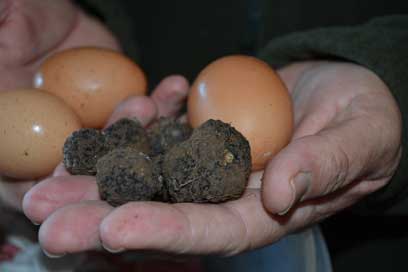
In fact, the Perigord is known for producing the very best black truffle, an aromatic fungus resembling a small black potato. To experience this local treasure, I spent a delightful morning at Truffiere de Pechalifour, the truffle farm of Edouard Aynaud, learning the art of truffle hunting.
Truffle farmer Edouard Aynaud
After meeting the high-energy Edouard, we entered a glass-doored, yellow stone building, where Edouard snaps open the lid of a large plastic bowl holding several black truffles, and thrusts it in my face. “Smell this,” he says in French, insisting that once you have this scent in your head, you’ll never forget it.
Edouard’s truffle-sniffing border collie
The valuable black truffle, sometimes called the Black Diamond, can command 1,000 Euros per kilogram, since the demand is always greater than the supply. Our host holds up a kiwi-sized truffle and we play “how much is this truffle worth?” My husband wins with his guess of 10 Euros, when the small scale records the truffle’s weight as 10 grams.
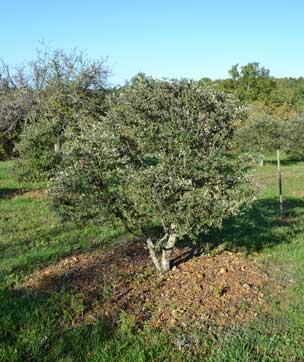
Now the lesson begins: truffles grow at the base of oak and hazelnut trees. The spores of the truffle form a web of mycorrhizal filaments that permeate both the soil and the roots of the trees. These filaments help the trees obtain nutrients from the soil, and in turn, the trees provide the truffle with needed sugars. Once this network spreads, there is a telltale brown circular area around the base of the tree called a “burn.” In the wild, this symbiotic relationship occurs with luck.
Here on the 10-acre Pechalifour farm, Edouard’s father planted his first trees in 1968. Today new tree seedlings with truffle spores grafted onto their roots are planted in the hopes of increasing the truffle crop. Edouard holds up a 2-foot-tall oak seedling to illustrate, and tells us that you must plant it and pray, and maybe in several years (3? 6? 10?) the telltale “burn” will appear. He explains that sadly, not many young people are getting into this business because it requires so much patience and optimism.
Edouard, however, personifies optimism and joy, explaining his craft in rapid-fire French (admirably translated by our local guide) and punctuated with animated facial expressions and gestures worthy of Marcel Marceau.
Once the “burn” is identified, there are three methods to locate the truffles beneath it:
With a pig. Grinning, Edouard holds up a Cracker-Jack-toy-sized pink plastic pig to illustrate. Furthermore, he continues, it must be a female pig. Why? Because the truffle scent mimics that of a male pig sex hormone.
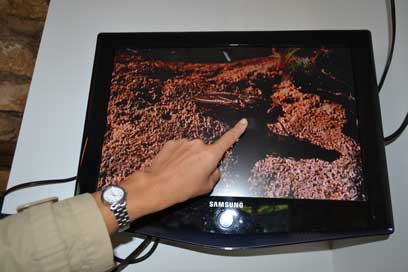
With a stick. Now he whacks a slender willow stick several times across the length of the table. Tapping a stick around the area of the “burn” disturbs a little brown fly that likes to lay its eggs on a ripe truffle, so that its larvae can feed on the nutrients. A short video illustrates that the fly’s brown color renders it invisible at rest. But once disturbed, the fly will rise up and then return to the location of the truffle, which must be harvested before the egg-laying, larva-eating process begins.
With a dog. The dogs must be trained while they are very young to recognize and search for the truffle scent. For that, Edouard uses the plastic film containers used before the age of digital photography. He pokes holes into the container and fills it with cotton that has been moistened with truffle oil. Then for one week he plays fetch with his canine student, rolling the container a little distance away, and rewarding the pup with treats and love when the prize is returned. The next week he hides the container in corners or behind something, and again rewards its return with treats and praise. The third week he buries the container outside under a little bit of soil and waits three days so that it no longer carries his human scent, but only the scent of the truffle, before sending the dog to find it. At the end of three weeks, with lots of praise and treats, the dog is trained.
Suddenly we are aware of a yellow labrador and a young black and white border collie snuffling around our feet, obviously eager to get to work. Edouard grabs a basket, some dog treats and a digging tool, and assuring us that he did not hide truffles ahead of time for us to find, we begin our spirited trek though the trees.
Pointing out brown fly in “burn” area where truffle lie
Walking slightly ahead of us, Edouard sees the telltale “burn” around the base of a tree, and gives his dog the command. Within seconds, the dog sniffs and puts his paw on a spot. Edouard scoops up a handful of the moist soil and sniffs it, crowing gleefully when he detects the scent of the hidden truffle. He pushes into my hands the special two-sided truffle-digging tool: pointed pick at one end, flat scraping blade at the other, and tells me to dig — but gently! We’re not digging up potatoes!
Tree with signs of a truffle underneath
Soon my delicate poking isn’t fast enough for him and he rakes his fingers through the mud until he isolates the prize. After pointing to exactly where I should look, he lets me make the final discovery. Voila! There it is — and it’s tennis-ball HUGE! But, alas, it is spoiled inside because of the recent unfavorable weather. Edouard rewards his dog with a treat and a cuddle, and then crushes the truffle with his fingers and reburies it on the spot, so its spores can sprout again.
The best months for harvesting ripe truffles in the Perigord is December, January and February, and then only if the weather conditions have been favorable — too much rain and they grow too fast and don’t ripen at the right time. All in all, it’s a business that needs luck — and lots of dog treats. www.truffe-perigord.com
By Don Heimburger Photos courtesy of the author, German National Tourist Office and Magdeburg Marketing
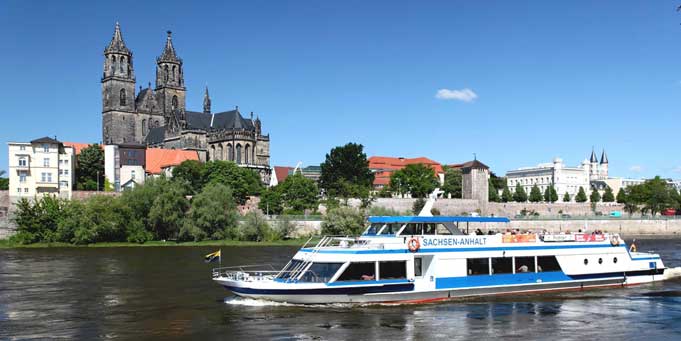
The Elbe River cuts through the heart of Magdeburg, offering this historic German city an idyllic landscape and picture-perfect views through a camera. But the city has seen its share of severe destruction over the centuries, such as in the Thirty Years War and World War II.
Today, this city of 240,000 in central Germany has rebounded nicely and combines its important and long history with new architecture, innovative cultural events and green spaces to make it an appealing attraction for tourists.
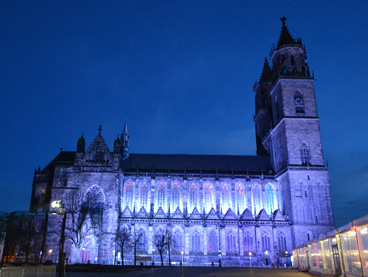
Aerial view of Magdeburg on the Elbe RiverMagdeburg Cathedral shines at night.
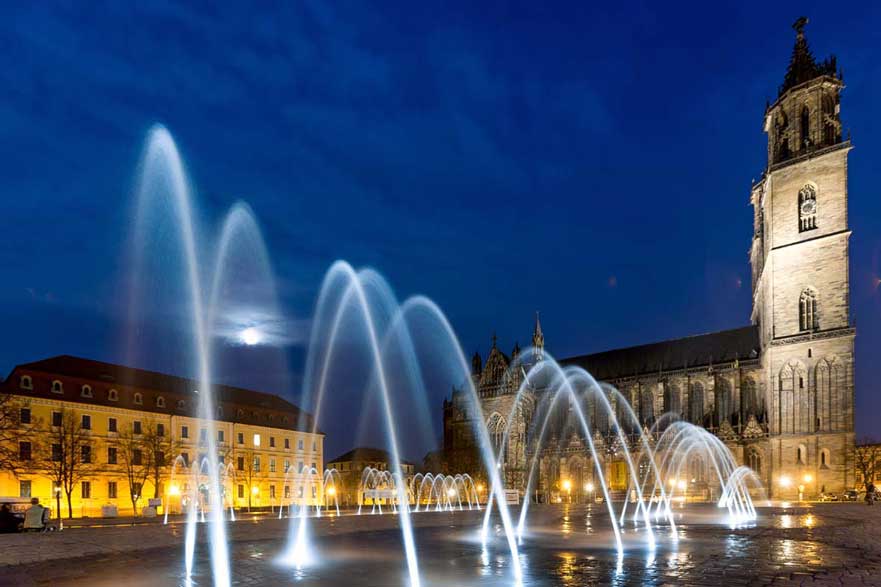
MAGDEBURG CATHEDRAL The town’s huge cathedral is a “must-see” and is the largest church building in this part of Germany. Surprisingly, the Magdeburg Cathedral can be traced back as early as 937, when Emperor Otto the First founded a monastery dedicated to St. Maurice. In 955, the church building was extended before becoming the cathedral of the established bishopric of Magdeburg in 968. Otto the First had a number of high quality pieces of antique art shipped to Magdeburg from northern Italy to the cathedral. These included columns made of purple-red porphyry, marble and granite, many of which still provide finishing touches to the architecture of the cathedral today.
Magdeburg Cathedral architecture
When Emperor Otto died in 973, his remains were brought to Magdeburg Cathedral, where he was buried in a stone sarcophagus. In 1207, the Ottonian cathedral was damaged in a city fire. Archbishop Albrecht II then began construction on a new Gothic cathedral, which was consecrated in 1362. The cathedral’s 341-foot-high west towers were completed in 1520.
Today, visitors to Magdeburg Cathedral can see the rich interior stone work which displays impressive architecture. The building is also full of unique and internationally renowned original exhibits representing nearly all periods of art history, including spolia from the building’s Ottonian predecessor, the original tomb of Emperor Otto I and his first wife Edith.
In addition, there are Romanesque bronze grave markers, early Gothic sandstone sculptures including the famous figures of the “Clever and Stupid Virgins,” the carvings on the choir stalls of the canons dating back to the 14th century, and Renaissance paintings, as well as 20th century art such as the famous war memorial designed by Ernst Barlach. The cathedral, which became protestant in 1567, is now the seat of a Protestant bishopric and home to members of a congregation in the city center.
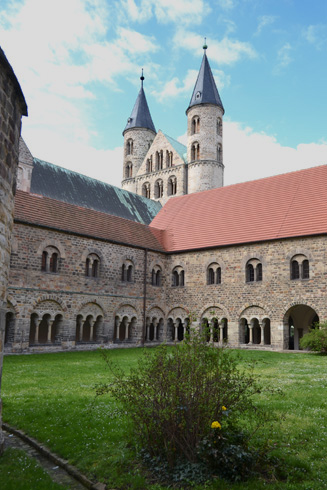
Monastery of Our Lady
MONASTERY OF OUR LADY Said to be the “pearl of the Romanesque Road,” the Monastery of our Lady in Magdeburg is considered the oldest surviving building in the city.
The unique well-house, magnificent barrel-vaults and sublime monastery church with its slender towers comprise an architectural marvel which is the centerpiece of all Romanesque buildings in Saxony-Anhalt. The structure holds both the Magdeburg Art Museum and the Georg Philipp Telemann concert hall. Archbishop Gero of Magdeburg ordered the erection of the building in 1017-18. However, nothing remained of the original construction, and it was Archbishop Werner (1063-1078) who arranged for the reconstruction which was finally completed in the 12th century by the Premonstratensian order.
The rotunda with its pointing cones, resembling a monk’s tonsure, is a remarkable architectural feature of the eastern wing. Together with its 32 arcades, the rotunda forms an ensemble considered one of the most amazing and interesting structures in European monastery architecture. After 1220, the monastery church was vaulted in early Gothic style. Also deserving a special mention is a collection of sculptures ranging from medieval to contemporary in the museum of the monastery. The surrounding area includes a sculpture park created in 1989.
St. John’s Church is Magdeburg’s oldest parish church, first mentioned in 941. The western section of the church, which features a late Romanesque design, and the Gothic hall church, have both been preserved. A monument of Martin Luther and the crypt of the Otto von Guericke family can be found in front of and inside the church.
The history of the church was marked by many changes: St. John’s fell victim to many city fires and was destroyed when General Tilly’s army invaded Magdeburg in 1631. However, the citizens never tired of rebuilding the church. St. John’s Church left its mark on history when an important and far-reaching event took place: on June 26, 1524, Martin Luther held a famous sermon on right and wrong justice in the greatly overcrowded church, whereupon all parishes of the city center converted to Protestantism, as laid down in the annals of Magdeburg.
Today St. John’s is open to the public and has become a popular venue for a wide variety of events.
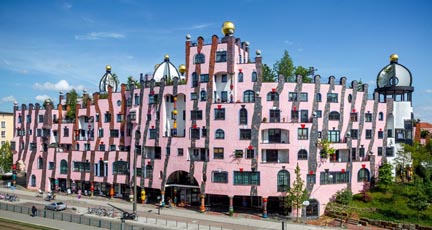
GREEN CITADEL OF MAGDEBURG One of Magdeburg’s most eye-catching attractions for visitors is also one of the last architectural masterpieces designed by the artist Friedensreich Hundertwasser. The Green Citadel of Magdeburg is located among a mixture of Baroque facades and examples of modern design and provides the Breiter Weg with a landmark structure and a burst of colorful culture.
This architectural retail/apartment building has been the subject of much discussion since it was constructed in 2005. It was the last building Hundertwasser designed before his death. The artist said the building was an “oasis for humanity and nature within a sea of rational houses” at the heart of the “concrete desert” of Magdeburg.
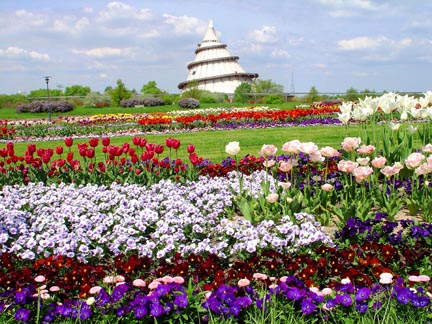
(left to right) Science demonstration at Millennium Tower; Millennium Tower
To explore the green of Magdeburg, visitors also want to investigate Elbauenpark. The park, which covers an area of 222 acres and was awarded the title of Germany’s second most attractive park in 2005, is home to many attractions that visitors can explore.
Since being created, the unique park has gained its place as one of Magdeburg’s most important landmarks. It is home to the Millennium Tower (the world’s tallest wooden construction of its kind), Lake Stage, Butterfly House and a number of playgrounds, sports areas, pieces of art, themed gardens and other attractions.
The park is home to a wide range of activities and facilities for sports fans, including golf, skating, rock climbing, hiking, biking, a high-rope park and even a toboggan run.
TOWN HALL OF MAGDEBURG The Town Hall of Magdeburg dates to the 12th and 13th century, with the oldest remains in the vaults which form part of today’s Ratskeller restaurant. Pelt dressers, tanners and dealers in hides and skins met here in the long hall to trade and stock their goods. After the turmoil of the 30 Years War, a two-story sandstone town hall building was erected in Dutch Renaissance style including Italian Renaissance architecture, and in the 19th century it underwent a number of changes and extensions.
In January 1945, the Town Hall was completely destroyed during an air raid, but reconstruction work on it began in 1965, and it was rebuilt and restored according to its original blueprints. The hall features bronze doors designed by Heinrich Apel and carved with historical figures and stories from the city’s past as well as features an impressive bell carillon with four octaves. The carillon is played on market days and also for concerts.
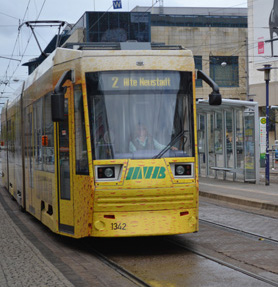
(left to right) Colorful street of buildings on Otto-Richter-Strasse; Magdeburg Town Hall with Statue of Otto I (912 – 973), Magdeburg, Germany. Otto I, or Otto the Great, was the founder of the Holy Roman Empire, reigning as German king from 936 until his death in 973.; Tram system in Magdeburg
NUMEROUS ART VENUES Today Magdeburg features numerous museums, art galleries, theaters and performing venues including the AMO, a multifunctional complex for shows, concerts and conferences. There is also the Stadthalle Magdeburg, the city’s civic hall. The hall was constructed in the style of the Neues Bauen modern architecture movement in 1927 for use as a showplace on the occasion of the German Theatre Exhibition. It has hosted a wide range of events such as classical concerts, theater performances, musicals, revues, ballets, galas, sports shows and rock and pop concerts.
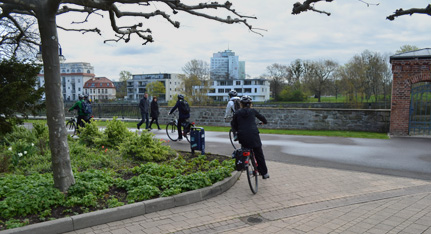
Magdeburg features miles of bike paths—this one is near the Elbe River.
MAGDEBURG ZOO Magdeburg Zoo is located at the heart of Vogelgesang Park, a natural and garden landscape that covers 47 acres. The zoo features 835 animals representing 176 different species. The man-made savannah landscape in the zoo covers an area of 215,000 square feet; the Savannah Viewing Point enables visitors to enjoy a panoramic view over the Africa area and the Water Bird Pond.
Magdeburg was the site of the 2016 German Travel Mart, attended by 1,500 participants from all over the world. Editor/Publisher Don Heimburger was on hand and filed this report about the green city of Magdeburg.











 European Traveler