Austria is a magnificent country that offers plenty of tourist attractions. One popular attraction is located in Werfen, Austria which is home to “Eisriesenwelt,” German for “world of the ice giants.”
Eisriesenwelt was discovered in 1879 by a scientist named Anton Posselt and is located inside of the Tennengebirge section of the Alps. Prior to Posselt’s discovery in 1879, hunters and poachers knew of its existence, but had never entered the cave. Although Posselt only explored 1/8 of a mile inside the cave, he published a report of his discovery a year later. It wasn’t until 1921 that Eisriesenwelt saw a large increase in the number of visitors to the cave.
Lamps are distributed to visitors who explore these breathtaking caves for a 75 minute tour. Visitors experience Posselt Hall, which holds the Posselt Tower stalagmite; the Great Ice Embankment, a formation towering over 75 feet; and the Ice Organ, created by the stalactites in Hymir’s Castle. The ice formations are sometimes highlighted with magnesium lighting for an added effect.
The Eisriesenwelt caves are open from May 1 to October 26, and during peak season tours are held every six minutes.
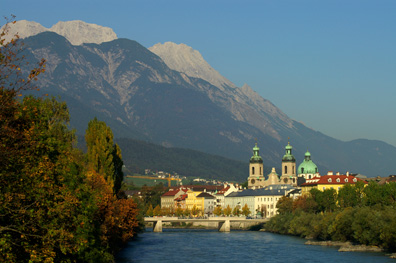
Innsbruck’s beautiful medieval Old Town, set against the backdrop of majestic peaks, is everything you picture a quintessential Alpine town to be. Yet its quaint appearance can be deceiving: a one-day tour will reveal a rich and varied side of Tirol’s capital underneath layers of ancient history and cherished tradition.
MORNING Before you do anything else, purchase a 24-hour Innsbruck Card either at your hotel or at the Innsbruck Information Office in the Old Town. This grants you access to all museums, public transportation, one roundtrip on any of Innsbruck’s lifts and cable cars and guided tours. Armed with the card, you are now set to start your day with a tour of the historic city center. You’ll love the colorful medieval buildings, vaulted walkways and stuccoed facades.
Golden Roof
Innsbruck’s landmark, the Golden Roof, is famously covered with exactly 2,657 gilded tiles and overlooks the main square. In the 15th century, the Habsburg family ruled their empire from Innsbruck’s Hofburg Imperial Palace.
See the Imperial Apartments and exhibitions at the palace, then stop at the adjacent Hofkirche Court Church, where one of the most important cultural monuments in Tyrol is on display: 28 larger-than-life bronze figures surround the 16th century tomb of Emperor Maximilian I, representing his heroes of antiquity and his ancestors. The quaint alleys of the Old Town also house many small boutique stores offering handcrafted Tyrolean products that make for excellent souvenirs.
AFTERNOON For lunch with a view, head past the Hofburg Imperial Palace to the Nordkettenbahnen Cable Cars. The funicular stations were designed by star-architect Zaha Hadid, and their sleek modern design contrasts beautifully with the surrounding landscape and historic architecture of the city.
Only 20 minutes later you’ll find yourself at 6,500 feet, near the top of the Nordkette Mountain range. Head to the restaurant at the Alpenlounge Seegrube and enjoy the breathtaking views over Innsbruck and the Austrian Alps. If you want to continue your mountain experience, head to the Innsbruck Alpine Zoo. Europe’s highest zoo features more than 2,000 animals including bears, wolves, eagles and many other species native to the region. To get there, simply take the Nordkettenbahnen back down the mountain and get off at the Alpenzoo Station. Otherwise, head straight back to the city in the early afternoon. It’s time to explore Innsbruck’s excellent shopping street, the Maria-Theresien-Strasse. Within view of the Golden Roof, the grand boulevard is located in a pedestrian area and—among many smaller shops and boutiques—houses two shopping centers: the ultra-modern Kaufhaus Tyrol designed by David Chipperfield and the Rathaus Galerien with boutique stores featuring well-known luxury brands. Don’t miss the Swarovski Flagship Store in the Old Town.
Maria Theresien
Another option for outdoor enthusiasts is to spend the afternoon taking part in Innsbruck’s fabulous summer hiking program. Visitors to Innsbruck and its 25 holiday villages can use the hiker’s bus with their Guest Card and explore the region with a free mountain guide. Even the equipment rental is free of charge with your Guest Card. Simply make a reservation through your hotel the day before.
EVENING You don’t really know a destination until you have sampled its food. Tyrol is famous for its hearty fare, such as Tiroler Gröstl (meat, potatoes, and onions topped with a fried egg) and a large variety of sweet and savory dumplings. The famous Café Sacher, a traditional Viennese coffee house and restaurant, as well as the Ottoburg, the Weisses Rössl or the Goldener Adler in the Old Town all feature excellent authentic cuisine. After dinner, head to the newly-opened Adlers hotel, housed in one of the city’s tallest buildings and enjoy a cocktail on the rooftop terrace, ending the day with a stunning view of Innsbruck by night.
A unique European hotel chain with individual flavor
by Don Heimburger
Are you headed for Germany soon?
Ready to order your airline tickets for this Western Europe’s most populous country?
“I want to see Germany in 2008,” says one traveler, “but I’m looking for a better-than-average place to stay, and I want something different and dependable.”
Let’s say you are flying into Frankfurt, then heading by train or automobile to Hamburg, Berlin, Dresden, and down to Nuremberg before heading back to Frankfurt.
You’ve scanned the websites of several hotels on your next trip to Germany (estimates are that 50% of guests now book on-line) and read a few guidebooks, but you find the smaller hotels or pensions aren’t rated, and the larger chain hotels all look the same, and it’s hard to distinguish one chain from another.
The four Steigenbergers, proprietors of Europe’s largest family-owned hotel chain.
ANY ZIMMER WON’T DO You don’t want just any Zimmer (room), because a few bad nights could ruin your trip. And you like hotels with some charm and some history.
The 2006 J.D. Power and Associates Study of European Hotel Guest Satisfaction (12,090 guests surveyed) found that nearly 70% of hotel guests in Europe prefer a smoke-free environment that exceeds the boundaries of their room.
And among 37 different possible amenities and services, complimentary breakfast (Fruhstuck) was the single most important amenity for hotel guests in Germany, France, Spain, Italy and Sweden. Only in the United Kingdom did complimentary breakfast follow coffee/tea as the most important amenity.
In the upper upscale segment of the European hotel market, the smallish family-owned, Frankfurt-based Steigenberger Hotels and Resorts group (81 hotels, mostly in Germany), received top 2006 J.D. Power survey ratings from guests in all seven key factors of guest satisfaction. The categories included reservations, check-in/check-out, guest rooms, food and beverages, hotel services, hotel facilities, and costs and fees. Steigenberger received 795 points on a 1,000-point scale, with Sheraton second and Hilton third.
In addition, Business Traveller magazine voted the firm in 2000, 2001, 2002 and 2005 as the Best Hotel Group in Germany.
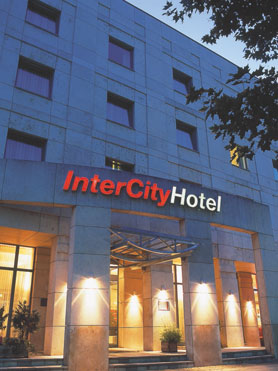
TWO CLASSES OF HOTELS Today, the chain of European hotels (53 four- and five-star hotels in the upper category, and 28 InterCity Hotels in the mid-range and business category which are located near key transportation hubs such as railway stations and airports), is owned by Anne-Marie Steigenberger and her daughters, Christine, Claudia and Bettina. Together, they own 99.6% of the company’s shares, with the remaining shares owned by others.
The firm’s shares aren’t listed on the stock exchange, so other hotel chains or investment firms can’t purchase controlling interest, and the Steigenbergers can run the hotels according to their distinct management philosophy.
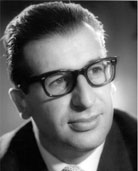
(left to right) Albert Steigenberger; Egon Steigenberger
FAMILY ACTIVE IN COMPANY The third generation of the Steigenberger family is active in the management of the firm, and together they assure patrons of their loyalty to the hotels they own and continuing growth and stability of the company. “For more than 75 years the name Steigenberger has stood for the very best in the European hotel industry, for tradition and innovation,” says company spokeswoman Mrs. Angelika Heyer.
The firm is the largest European hotel company still in family ownership. Three of the four female Steigenbergers live in Frankfurt, and one resides in Vienna.
The Steigenberger family of four women have very specific ideas of what their hotels should do for customers. “For many years, our hotels have symbolized top-class European hotels providing incomparable hospitality and perfect services,” explains Karl Schattmaier, chief executive officer. “Our current offerings mirror the wishes and demands of our guests.”
In 2006, the chain had its most successful year, with a 10.6% increase in gross revenues to 475.4 million euros ($636.5 million dollars) from 429.8 million euros ($575.5 million dollars), while operating profit rose by 31.4% to 11.3 million euros ($15.13 million dollars).
The firm attributes the increase to a good economic climate, an exceptional Football World Cup and pairing down of its corporate structure.
With majority interest in the firm, the four Steigenbergers can direct the hotel’s growth, customer and business affairs. “We offer every convenience and service that guests expect from modern luxury hotels,” says Heyer.
INDIVIDUALITY OF EACH HOTEL The Steigenbergers don’t consider their Hotel and Resort grouping as a hotel chain per se. The individuality of each hotel is retained by the management, and there are substantial differences in the interior and exterior appearances of the structures themselves.
Even the personal service from the hotel staff is by special design; it starts at its own Steigenberger Academy in Bad Reichenhall, Germany. The hotel company is the only European group with its own private training academy and state-approved vocational hotel college.
The academy programs include training in restaurants and hotels, and business administration with one-, two- and three-year programs. About 250 students are enrolled at any one time, and the Steigenberger Hotel group often recruits its own staff from the academy. “We offer them training positions as well as permanent positions in the hotels,” explains Heyer.
Despite its small size, the firm has big plans, and last year augmented its hotels by six more: Hotel de Saxe in the center of Dresden, a 178-room four-star facility with seven suites and 10 conference rooms; the 121-room Strandhotel Zingst on the Baltic peninsula, a first-class hotel built in the classical spa style; and the four-star, 135-room golf hotel Treudelberg in Hamburg features an 18-hole championship golf course.
HOTEL DE SAXE, DRESDEN The Hotel de Saxe in the center of Dresden, across from the Frauenkirche on the Neumarkt, was constructed following the style of the first Hotel de saxe built in 1756, which was one of the best hotels in the Saxon metropolis.
“I stayed here in August 2006,” said a visitor from London who was quoted on http://www.TripAdvisor.com. “The hotel had just opened; even the carpets had that fresh smell. My room was of a good size, impeccably clean, good bed and bathroom.”
Another said, “The location couldn’t have been better—right across from the main part of town, (within) walking distance to everything in Dresden. The hotel staff was very friendly and helpful.”
BALTIC SEA RESORT: STRANDHOTEL ZINGST At the Strandhotel Zingst, located on the sandy beach and the Baltic Sea north of Hamburg, rates for a two-night stay in September were quoted at between 82 Euros for a room type assigned when you arrive and 186 Euros for a deluxe room. A highlight of the hotel is a very large Spa Pavilion in the hotel garden with inside and outside pools, and many spa-like amenities and facilities.
At the Hotel Treudelberg in Hamburg, 30 minutes from downtown Hamburg, a visitor said the hotel would rate between a 4- and 5- star experience with comfortable beds and a good breakfast buffet. In 2008 the hotel is expected to add another 95 rooms and extend the golf course to 27 holes.
At Trivago.com, the hotel is rated overall 95 points out of 100, with Rooms rated at 100, Amenities at 98, Food & Beverage at 98 and Location and Surroundings at 92. Not all travelers are going to find Steigenberger or other hotels to their liking, naturally.
The other three new hotels the firm added recently were in Italy and Egypt. Their InterCity Hotel division plans on building three new hotels in Essen, Dresden and Mainz, Germany in 2008, and a luxury four-star hotel in Vienna Old Town (Austria) is also slated by the company.
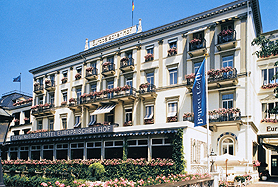
BACKGROUND: FROM WASH HOUSE TO FIRST-CLASS RESORT The first Steigenberger Hotel was once the municipal washhouse for Baden-Baden, where townswomen of Medieval times went to do their washing.
In the mid 19th century, when Baden-Baden, located in the Black Forest, began to flourish as a spa, the site was taken over by the Hotel Europaischer Hof. Heads of state stayed at the hotel, and its location across from the pump rooms and assembly rooms attracted good business and an international reputation.
When a world economic crisis arose, the hotel borrowed heavily from a businessman in Lower Bavaria by the name of Albert Steigenberger. As business remained poor, the hotel was auctioned, and Steigenberger became a hotel owner.
In determining how the hotel had done poorly, Steigenberger did something unusual: he tried out every room in his hotel and decided to invest in modern comfort and convenience.
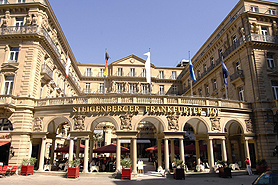
BUYS FRANKFURTER HOF Later, in 1950, he acquired the rundown Frankfurter Hof in Frankfurt am Main, which is today’s flagship five-star hotel and now lavishly refurbished (in 2006). The hotel was selected as one of the top 50 hotels in the world for its standards and services in 2005 and has won other recent awards, as well.
The next hotel acquired was the Vier Jahreszeiten in Wiesbaden. And then the Monopol-Metropol at Frankfurt’s main train station. Many more acquisitions followed in Baden-Baden, Dusseldorf, Mannheim and Stuttgart.
In 1958 Albert’s son, Egon, took over the business, and in 1963 the firm purchased their first hotel outside of Germany. In 1972, the Hotel Training College was added to the fold, and in 1985 the firm was made a joint stock ownership company.
Last year the company employed 5,580 staff. The firm runs the Hotels & Resorts Group which preserves classical elegance in the style of the great European hotel tradition, and the InterCity Hotel group which provides business class comfort in a strategically located hub near airports and train stations. InterCity Hotel guests are offered tickets for local public transportation gratis.
During the next few years, l50 million euros will be invested in the hotel’s operations via extensive rebuilding and modernization, with emphasis on the restaurants and spa areas. Resort hotels will focus on spa/wellness, golf, sports or leisure activities or families.
As an example, if the hotel caters to golfers, a special concierge with knowledge of the local golf facilities will be made available to guests, says Steigenberger.
Overall, Steigenberger properties seem to be a good deal, with above-average visitor reviews, and more capital investment expeditures coming through 2008 to their hotels and resorts.
European Traveler reporter Steve Ramsey visited Steigenberger’s Frankfurt Airport Hotel and filed this report:
EUROPEAN TRAVELER’S ON-THE-SPOT VISIT
During a recent visit to Frankfurt, I stayed at the Steigenberger Hotel, located just minutes from Frankfurt’s International Airport. From the courteous greeting at the reception desk upon arriving to an efficient checkout the following day, I appreciated the Steigenberger’s modern style and comforts.
Don’t let the plain exterior of the building fool you: the contemporary interior is very appealing. A relaxing lounge sits directly across from the vibrant reception desk as you enter the hotel. The three-winged building has long, blue, carpeted hallways, which house more than 550 rooms on eight floors. Quiet music, only played during the day, and a chic lighting system illuminated the hallways as I made my way to my room.
The room was very well kept and was furnished with two comfortable twin beds. A desk and leather chair sat beneath two large windows, which overlooked nearby surrounding forest. Located in the wing facing away from the airport, I did not hear any airplanes, even with the window open. The bathroom really makes a statement and sets the hotel apart from its competition. It contained a cylindrical shower with a curved sliding glass door. An overhead rain-shower faucet was adorned with small blue starlights embedded in the ceiling. A raised bowl sink and green marble floors provided additional nice touches.
A quick note to inexperienced travelers–if you have trouble turning any of the room lights on, put your keycard in the slot next to the door as you walk into the room!
The breakfast buffet, which is not included in the room price, had a lot to offer. Included were several different types of breads, juices, omelets, cereals, meats and fruits… everything was fresh, and they were well prepared to satisfy international guests. While it may seem pricey by American standards, 23 euros is pretty standard for hotels in the area. As a cheaper alternative, try one of the shops in the train station.
I enjoyed my brief visit at the Steigenberger, and I would recommend it to anyone staying near the airport. The staff was professional, yet personable, and quick to offer their help. There is a free shuttle that runs every 15 minutes to and from the airport, and the downtown area was about a 10-minute car ride from the hotel, so be sure to visit the city center, even if you are in town just for the night!
IF YOU GO…
Location Next to the forest, Frankfurt airport 0.9 km, A3/A5 motorways 1 km., airport railway station 1.8 km, city center 10 km, Frankfurt main train station 10 km, fair and exhibition center 12 km
Accommodation 553 rooms and 20 suites, air-conditioning, sound proofed, telephone with voicemail, modem link, high speed Internet access, non-smoking floors, special room for the disabled
Restaurants and Bars 4 restaurants including 1 gourmet restaurant, 1 lobby-bistro-bar (24-hr.), 3 terraces
Whether it’s your first time to Europe, a romantic vacation for two to Paris or a family trip to London, international travel can seem a little daunting. With proper planning, you can kick off your vacation on the right foot.
1. Educate yourself on the culture: It is important to be mindful of other cultures when travelling internationally. Be sure to study up on any common cultural mistakes that travelers make when entering the country you are visiting. This will safeguard you from making the same embarrassing and offensive mistakes.
2. Review rules on air travel and luggage: Save time (and stress) at the airport by checking the TSA website’s list of prohibited items. No one wants to start a trip having to repack their luggage at the airport or getting stuck in customs.
3. Make copies of important papers: most people know that proper documentation is needed for international travel, but how many people think to bring copies with them? Take the time before you leave to keep a copy of all your documentation in your email, just in case something happens. Have an unlocked mobile phone? Be sure to keep a copy on there too. (If you don’t, think about purchasing one.)
4. Check out the local forecast: in order to know what to pack, it is important to know the typical weather where you are going in the time frame you are going. You should also check the local weather a few days before you leave.
5. Purchase an unlocked cell phone: Stay connected with those at home by purchasing an unlocked mobile phone. Purchasing an unlocked GSM phone will allow you to access pay-as-you-go plans internationally, saving on roaming fees. This kind of connectivity can give you piece of mind in knowing, wherever you are, you are always connected.
If a short break is on your agenda for St. Valentine’s Day, perhaps you need a push from the man himself — St. Valentine. Wouldn’t you know it? The Irish actually have relics (some of the remains) of the patron saint of lovers.
You need to head to Dublin for this. The St. Valentine’s Shrine is in Whitefriar Carmelite Church, Aungier Street, a few minutes walk from Grafton Street, St. Stephen’s Green and the famous Temple Bar, the center of Dublin’s shopping, culture and craic in the Irish capital.
If you can, visit St. Valentine’s Shrine on February 14 itself—the saint’s actual feast day, and the origin of the annual celebration of love, although it’s still a place of pilgrimage for those celebrating love at any time.
You can do a lot in Dublin on a long weekend. In Europe’s friendliest city; you can talk to anyone. It’s said the city is as intimate as a pub. But it’s probably better not to over-prepare for Dublin, or anywhere in Ireland. Be ready to go with the flow, build in one or two key activities and expect the locals to throw a surprise or two your way.
Dublin hotels and restaurants will be pulling out the stops to create a traditional romantic atmosphere on Valentine’s night, so candle-lit dinners will be the norm. Flowers are no problem either— Smithfield Flower Market — and one Dublin temple to the art of all things— chocolate— is actually not far from St. Valentines’ Shrine. Chocolatier Cocoa Atelier on Drury Street oozes handmade Irish chocolate deliciousness.
Finally, the all-important card.The Emerald Isle’s charm is more along the style of literary son Sheridan: “Won’t you come into the garden? My roses should like to meet you.”
Ireland is a land that reaches deep into the heart, lifts spirits and stirs you to your very core.











 European Traveler