For the millions of RMS Titanic lovers around the world, April 15 is a very significant date. On that day it will be exactly 100 years since the tragic sinking of the ship that changed so many lives and sparked one of the most captivating stories in human history.
On March 31 the world’s largest Titanic visitor attraction, Titanic Belfast, will officially open its doors, thrusting the ship’s physical and spiritual home firmly into the global spotlight.
The striking $152 million piece of modern architecture stands majestically at the head of the very slipways where the Titanic first glided into the waters of Belfast Lough.
Inside, nine walk-and-ride-through exhibition galleries equipped with the latest 3D, CGI and video technology uncover the true Belfast story of the Titanic, from its conception and construction in the Harland & Wolff Shipyard to its famous maiden voyage and subsequent place in history.
A host of experiences are offered—a thrilling ride through the shipyard with the Titanic under construction, or an exploration of the sumptuous luxury and superb craftsmanship of its interiors.
You can be drawn deep into the stories of the passengers, crew and the heroes of the day or re-live the drama of its tragic end and visit its resting place in the North Atlantic in a unique Ocean Exploration Center with live links to contemporary undersea exploration.
Consists of 870 miles of trails from soaring cliffs to golden sands
Photos courtesy Visit Britain
The Wales Coast Path creates a complete path along the whole Welsh coastline, and together with the Offa’s Dyke Path, the total route extends to more than 1,000 miles. The Coast Path winds its way through towns and villages, across cliff tops and sandy beaches, sometimes darting inland before emerging at a sheltered cove or tiny hamlet that you would forever miss when traveling by car, bus or train.
The Wales Coast Path has been developed by the Welsh Government in partnership with the Countryside Council for Wales, 16 local authorities and two national parks. In addition to funding from the Welsh Government and the coastal local authorities of approximately $3.15 million per year, the European Regional Development Fund has allocated $6.29 million over four years in support of the project.
Improvements to the quality and alignment of the route will continue during 2012 and 2013 to ensure that the path follows the Welsh coastline as close as it is safe and practical. Over time, the Wales Coast Path is expected to lead to the creation of circular coastal routes as links to inland towns and villages are improved.
Wales is a country blessed with a beautiful coast and stunning scenery. The Wales Coast Path will ensure improved access to the coastline and encourage people to live a healthier and more active lifestyle.
SHAPE OF THE NATION
In the northeast, on the border between Wales and England, the path sets off near Offa’s Dyke, near the coastal town of Prestatyn on the shores of the Irish Sea. This historic dyke is named after the 8th century King Offa, who ordered the dyke be built to separate his kingdom of Mercia from rival kingdoms in what is now Wales. This 177-mile path, forming one of Wales’ three national trails, runs along the Anglo-Wales borderlands. With the development of the coastal path, this will enable visitors to walk around the whole of Wales.
This historical journey continues as the path winds through nearby Conwy with its impressive 13th century castle built by Edward I. The coastal path passes a number of other medieval castles along its way such as Caernarfon, Beaumaris, Criccieth and Harlech in the north, Aberystwyth in mid Wales, and Cardiff and Caldicot in the south. It passes by ancient churches such as St. Hywyn’s in Aberdaron on the Lleyn Peninsula, where since medieval times, pilgrims have come on their way to Bardsey Island, the legendary Isle of 20,000 saints.
All along the coastal path there is breathtaking scenery; places such as Anglesey in the north and Pembrokeshire in the south are especially beautiful. In western Wales, a half mile section of the path recently opened joins the Ceredigion Coast Path with the Pembrokeshire Coast Path National Trail creating a 250-mile unbroken path. Last year, National Geographic voted Pembrokeshire “one of the best coastal destinations in the world, a wonderful part of Wales that must be seen and explored.” There are a variety of beaches along the way, ranging from expansive stretches of sand to tiny sheltered coves.
The wildlife that can be seen while exploring Wales’ coastal path is rich and diverse. Exploration of the coastline along the path reveals bays, headlands, towering cliffs and inlets, all provide stunning views of nesting seabirds, guillemots, razorbills, puffins and shearwaters. Out to sea off the Ceredigion Coast in Cardigan Bay, bottlenose dolphins and porpoises can be seen playing in the surf, and its sheltered inlets and coves harbor Atlantic grey seals basking on the beach or bobbing up and down in the sea.
Wales is famous for its seaside resorts. Among others, the path passes through Tenby in the Southwest, a town steeped in history, renowned as being one of Britain’s finest holiday resorts, and in the north, Llandudno, Wales’ largest resort, a town that has kept its Victorian and Edwardian splendor and boasts two great beaches.
Situated along the coastal path are some of Wales’ finest inns such as the Ty Coch Inn nestled in the tiny fishing village of Porthdinllaen on the north coast of the Lleyn Peninsula, with views across the Irish Sea and with a sandy beach on its doorstep, boasting a fine selection of food and ales.
The number of walkers along the coast is increasing continually, but the path is also suitable for cyclists and horseriding on large stretches and also invites the disabled along its length.
Set deep in the countryside, surrounded by forests and vineyards, Tripsdrill opened in 1929—Germany’s first theme park.
About an hour’s drive southeast of Heidelberg, the park revels in nostalgia, reflecting the Swabian region’s tradition and history. Tripsdrill is set on 190 acres, with 100 one-of-a-kind attractions, including the 100-foot-high “Mammoth” wooden roller coaster. Activities include water sports for the whole family, action rides for thrill seekers and interactive play for children.
In 2012, the Village Street will be enlarged. The new timbered house is typical of Southwest Germany, and its three floors will be devoted to a variety of games for older and also younger children. The year 2012 also marks the 60th birthday of the federal state of Southwest Germany (Baden-Württemberg), and Tripsdrill is joining in the fun with a series of special events to celebrate all aspects of Swabian culture.
The neighboring Wildparadies Tripsdrill (wildlife park) is devoted to wild animals native to Europe. Celebrating its 40th birthday in 2012 with plenty of wildlife action and excursions, this park also has a new feature: overnight stays. Visitors can stay in a shepherds’ wagon or a comfortable treehouse deep in the forest.
Prime location in the center of Frankfurt’s bustling downtown
By Don Heimburger Photos by the author
This German 297-room hotel is more than 100 years old, having been built in 1905 as a palace with 77 rooms and suites, designed in the Art Nouveau style.
There are also 220 guest rooms in the newer wing which are highlighted by clean lines and modern design. At night, the hotel’s welcoming exterior sign, in lights and in a script style of writing, gives the hotel’s entrance a unique flair.
Located within easy walking distance of the main Frankfurt train station, the hotel is convenient for leisure as well as business travelers, as the main Frankfurt Trade Fair Center is only five minutes away. The museum district is also close by.
NEAR IDYLLIC PARK AREA The hotel is located on the quiet and idyllic Wiesenhuttenplatz, and in the summer months you can sit underneath the towering chestnut trees in the beer garden La Jardin and sip your favorite beverage.
Marble lobby floors, dark wood paneling accents and plenty of room to maneuver luggage give the hotel’s entrance floor a graciousness and style. A cozy bar, the Morocco-style Casablanca with high-backed leather chairs, at one end of the lobby, beckons thirsty guests to come in for some relaxation. The sign over the bar’s door from the lobby side is a light-projected image. Just down the street is a lively bar/restaurant area should you want to mingle with the street crowd. The reception desk or concierge can direct you.
As at many of the other hotels in the vicinity, there is a choice of room types, with varying degrees of comfort, space and amenities. There are 25 Classic rooms located in the historical palace portion of the hotel, with high ceilings and real Italian marble in the bathrooms. The average room size here is about 130 square feet.
Superior rooms, and there are 177 of them, are in the modern business wing of the hotel and offer 270 square feet of space. Modern in design, the rooms feature a television with a LCD and plasma screens (and a handy mirror on the other side of the screen), a safe and a complimentary bottle of mineral water.
Executive rooms— with about 322 square feet of space—are in the historical palace portion of the building and provide decor in the Art Nouveau style but with modern amenities. The Deluxe rooms, with 355 square feet of space, offer more room for a comfortable stay. There are also Junior Suites, with about 485 square feet of space— available with separate living and sleeping areas. These are in the Art Nouveau style, and offer classical elegance with very high ceilings, inviting color tones and bathrooms featuring Italian marble. The hotel also says you receive the “VIP” treatment when you book a room of this category.
INVITING BREAKFAST Buffet-style breakfasts consist of smoked salmon, cold cuts and cheese, eggs to order, soft boiled eggs, dried cereals, yogurt, juices and coffee, fresh cut fruits, apples, oranges, bananas, jams and jellies, a variety of breads and pastries, plus more.
The spacious, modern Restaurant La Parc off the lobby, with Sven Frambach as chef, offers a mix of both traditional classics and newer dishes. Using fresh ingredients, seasonal accents and Frambach’s expertise, each dish is “a little piece of art.” The menu is a la carte, with monthly specials, and culinary events are planned throughout the year. As an example, pumpkin was recently featured through the first week of November, then goose was the specialty of the house.
The restaurant is open between 6:30 a.m. and 11 p.m. There is also a business lunch buffet that alternates specialties from time to time. Every Friday starting at 6:30 p.m. there’s a special Laurent’s dinner buffet, inspired by French cuisine and accompanied by piano music. The price also includes a glass of Laurent-Perrier champagne, a carafe of the red or white house wine and mineral water.
The White Stone Lounge wellness center in the hotel offers saunas, herbal steam rooms, massages, cosmetic treatments, manicures and pedicures and exotic applications such as lotus petal facials and body peelings. A gym is also open daily between 5 a.m. and midnight.
Having come to the hotel from the main train station, and it was raining heavily, I was glad to see the Le Meridien such a short walk from the station. The reception clerk offered a friendly greeting, and quickly I was off to my room.
Convenient location, personable employees and some historic atmosphere make for a good mix at the Le Meridien.
Easter celebrations are among the oldest, most traditional and unique celebrations in Germany. A myriad of differing regional traditions, Easter markets and special celebrations start weeks before the four-day Easter weekend from April 5 to April 9. Many of the American Easter traditions, including egg decorating, Easter trees, Easter egg games and, of course, the chocolate Easter bunny, were brought to America by German immigrants.
In preparation for Easter, towns decorate their fountains and trees with eggs and wind crepe paper around the branches. On the Easter Eve, bonfires are lit celebrating the new and getting rid of the old. Easter markets throughout the country exhibit Easter eggs and spring-themed local arts and crafts in surroundings from historic cities and castles to landscape parks. The markets last either a few weeks or a weekend and are a favorite leisure time activity for locals and tourists alike.
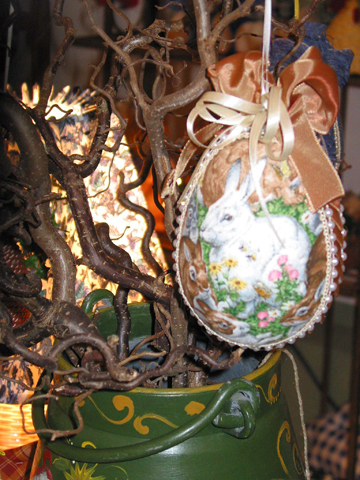
Easter decorations
EASTER MARKETS Being one of the oldest Easter markets in Germany, the Haeferles Market in Nuremberg in Franconia is the first major event of the spring season. With over 80 stalls in the middle of the historic city center, this market offers everything around the Easter holidays, from hand-painted eggs to wooden decorations (March 23 – April 9). Further to the north in the charming town of medieval Wolfenbuettel, about two hours from Frankfurt, the Easter market takes place in a royal surrounding. In the courtyard of the 18th century residence castle of the Guelphs in the city center, over 60 artists and craftsman from the region display their works on the weekend before Easter (March 31 – April 1). Then, on Easter Saturday a huge rabbit emerges from an enormous nest and distributes candy to the children.
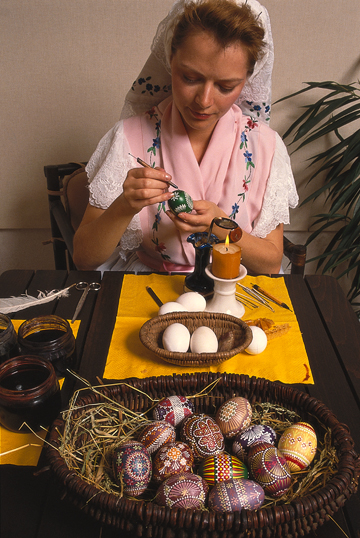
Lady in Sorbian costume handcrafts traditional Easter egg painting using wax-resist techniques.
EASTER DUCK RACE The festivities are closely followed by a duck race where the ducks are thrown into the river and race to the other side. One of the largest Easter Egg Fairs in Germany takes place in the beautiful landscape park Luisenpark in Mannheim from March 31 to April 4. The International Easter Egg Market at Mannheim’s Baumhainhalle hosts over 40 artists from Germany, Russia, France, Switzerland and Hungary.
St. Wendel fountain decorated for Easter
KREUZTRITT WALK PARADE A very special Easter culture exists in eastern Germany near the border with Poland. The Sorbs, a Slavic minority that has lived for generations in this area called Lusatia, celebrate Easter with a parade called the “Kreuztritt” (Cross Walk) on Easter Sunday. The men of the village dressed in traditional costumes of black jackets and top hats, ride horses in a circle from town to town announcing the resurrection of Christ. The Sorbs also are masters in the art of Easter egg painting. Sorbian artists from all over the region exhibit their skills during the Lenten season. The Egg Rolling and colorful Easter Market on Easter Sunday are wonderful highlights during the Easter weekend, April 7 and 8.



 European Traveler